
Jesus.
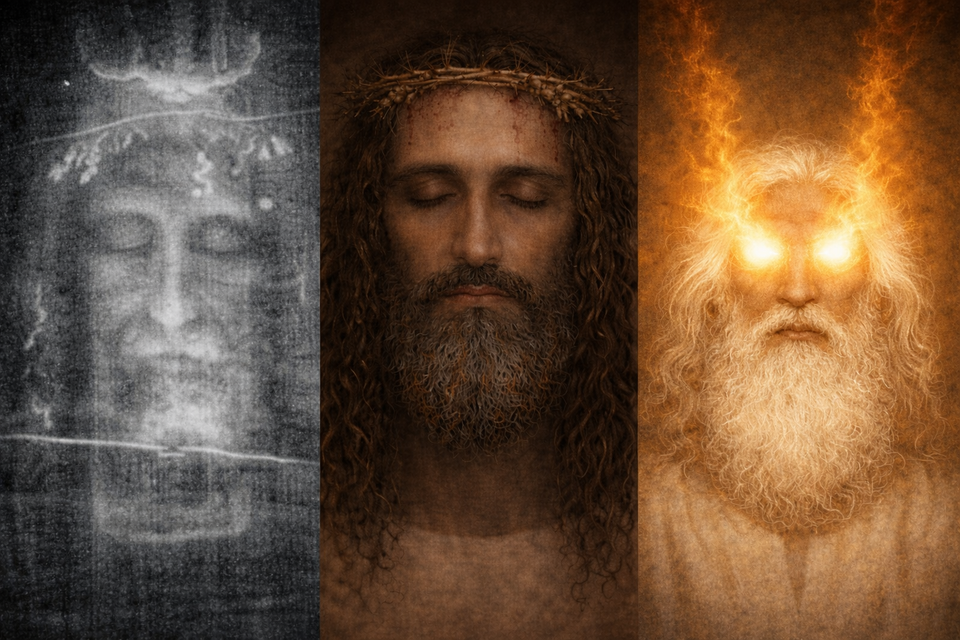
The covenant arc from Abraham to the table that is set
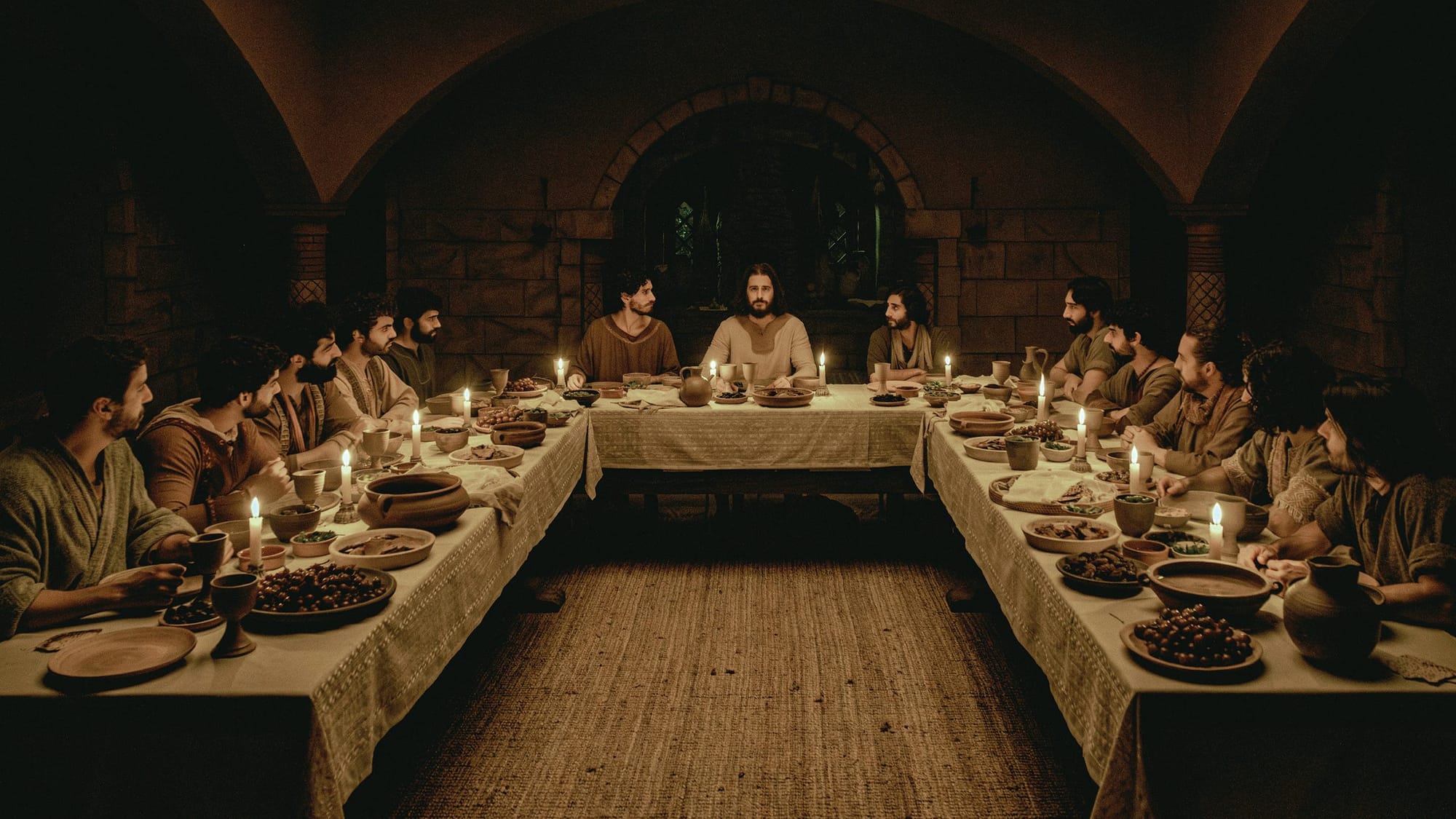
There is a moment in The Chosen: Last Supper when the room goes quiet. The disciples have been arguing. Peter is performing certainty he does not feel. Judas has already made the calculation. The crowd that shouted Hosanna four days ago is cooling into the mob that will shout Crucify by Friday. And Jesus lifts the cup. Five seasons of television have earned this silence — earned it by doing the one thing most retellings refuse to do: showing the people at the table as people. Not icons. Not theological positions. Fishermen, tax collectors, a zealot, a traitor, and a dozen ordinary men who followed someone they could not fully categorise into a week none of them would survive intact.
The audience knows what is coming. The disciples do not. And the man holding the cup knows something neither the audience nor the disciples can access: he knows when the cup will be lifted again. "I will not drink again from this fruit of the vine until that day when I drink it new with you in my Father's kingdom." The vow is spoken in an upper room in occupied Jerusalem, under Rome's fourth beast, inside the very week Daniel's sixty-nine weeks computed five centuries earlier. It specifies a cup, a table, a kingdom, and a day. The Person speaking sees the day — because the Person speaking is the one who authored the day, who deposited four integers in Babylon that would remain computationally inert for twenty-five centuries until the calendar caught up with the architecture. The chair at that table has been empty for two thousand years. Every Passover, a cup is poured and not drunk. A door is opened and no one enters. This essay is about when the door opens, who walks through it, and why the coordinates are no longer sealed.
The Empty Chair
Every Passover, a chair is left empty at the table. A cup is poured and not drunk. The door is opened and no one enters. The chair is for Elijah — the prophet Malachi promised would return "before the great and dreadful day of the LORD" (Malachi 4:5). The last words of the last Hebrew prophet, followed by four hundred years of silence.
The chair was filled once. John the Baptist came "in the spirit and power of Elijah" (Luke 1:17), and Jesus confirmed it: "If you are willing to accept it, he is Elijah who is to come" (Matthew 11:14). The forerunner arrived. He was beheaded at Herod's banquet — the wrong table, the wrong king, the wrong cup. And the chair went empty again.
At the last Passover before the cross, Jesus lifted the cup and made a vow: "I tell you I will not drink again from this fruit of the vine until that day when I drink it new with you in my Father's kingdom" (Matthew 26:29). The vow was spoken inside time by the Person who sees all time. It specified a cup, a table, a kingdom, and a day. The coordinates of that day are computable from four integers a prophet received in Babylon five centuries earlier.
I've spent the last year building toward this essay. Ehyeh Asher Ehyeh derived the physics — ten levels from Landauer's principle through the holographic encoding to the Trinitarian structure, formally proved in Coq 8.18. The Coincidence Stack and The Singularity/Eschaton demonstrated that the post-1945 world is statistically dislocated from the prior nineteen centuries at 109σ — and that within that dislocation, one specific seven-year window (2026-2033) exhibits prophetic architecture with a probability of approximately 10^-79 under coincidence. The Tesseract showed that the architecture has geometry — the Diamond Chiasm, the validation circuit, the checksums. Crossing the Threshold drew the personal conclusion: the threshold for skepticism has collapsed.
This essay is the story those numbers were built to hold. It traces the arc — from the first promise to Abraham, through the carrier nation, the prophetic portrait, the first-century convergence, the cross, the gap, the nations' inclusion, and the cascade now unfolding — to the table where the cup is waiting. If you've read the corpus, you'll see where every thread lands. If you haven't, this essay is designed to stand alone — but I'd encourage you to read the others, because the math matters, and the math is there.
I. The Seed and the War
Before Israel, before Abraham, before the flood — the war. But before the war — the physics. I need to lay this ground before the story begins, because without it the theology floats free. With it, the theology is derived. The full derivation runs to formal proof in Ehyeh Asher Ehyeh — seventy-three theorems, zero errors, Coq 8.18 and Lean 4. What follows is the chain. Ten levels. Each feeds the next. Each is independently verifiable.

The identity chain (Level 1): E=mc². Energy = information (Landauer's principle, verified in Nature 2012). At the Planck scale the ratio locks to log₂(e) = 1.4427 — a mathematical constant. Mass, energy, and information are one quantity measured three ways.
The holographic encoding (Level 2): Two independent calculations — holographic bound and Bekenstein bound — both yield 2.2655 × 10^122 bits. Ratio: S_bek/S_hol = 1.000000. All information is encoded at a two-dimensional cosmological boundary surface. The three-dimensional interior is generated by that boundary. Flatness (Ω = 1.0007 ± 0.0019) maximises the boundary's capacity — the geometry that sustains the most reality.
The branch problem (Level 3): Statistical mechanics gives e^(10^122) possible configurations with full ontological status in the quantum formalism. They must exist somewhere. Where?
The Mind Proof (Level 4): Three independent proofs eliminate all options except knowledge in a mind. Decoherence destroys macroscopic superposition below the Planck timescale (for a human body: 0.007 Planck times) — eliminates physical coexistence. The regress proof shows that physically instantiating all branches costs e^(10^122) energy-information units, diverging to infinity; Cantor's theorem seals it — eliminates parallel universes. Wheeler-DeWitt (Ĥ|Ψ⟩ = 0) requires the container to be timeless, complete, and selective; Platonism satisfies the first two but has no selection mechanism — eliminates abstract existence. Surviving option: knowledge in a mind. Cost to know all branches: 10^122 bits — finite.
The Thinker Proof (Level 5): Five movements characterise the mind. (I) The universe's compression ratio of 10^-118 proves non-randomness by Kolmogorov theory — requiring a source with algorithmic information ≥ K(U). (II) The actualisation function mapping branches to "actual" or "not-actual" must satisfy three empirical conditions — Penrose low-entropy initial state, content-responsiveness, completeness — and any function satisfying all three constitutes rational agency by mathematical definition. Agency is derived from physics, not asserted. (III) Russell-Cantor proves the container cannot be the universe (insufficient information) or the multiverse (self-containment contradicts Cantor's theorem). It is external to both. (IV) Four independent arguments — Wheeler-DeWitt timelessness, block constraint-satisfaction, selection completeness, information non-decomposability — prove the container is omni-temporal. (V) Six predictions — correlated fine-tuning, exact flatness, spacetime from information (ER=EPR), quantum error correction in spacetime (Almheiri-Dong-Harlow), total energy exactly zero, the hard problem of consciousness persisting — all confirmed. Zero falsifications.
The Thinker Theorem (Level 6): Seventeen premises, each empirically measured, mathematically proven, or logically derived. One conclusion: an omni-temporal, omniscient, sovereign mind external to spacetime is the informationally necessary ground of physical reality. This is not a god-of-the-gaps. Every scientific discovery that reveals a deeper law increases the compression ratio and strengthens the conclusion.
The Trinitarian structure (Level 7): The Curry-Howard-Lambek correspondence requires exactly three irreducible operations to produce anything: formation (type conceived), introduction (term specified), β-reduction (specification actualised). Remove any one and nothing can exist. Robert Harper called this "computational trinitarianism" — the threefold structure is mathematically inescapable. At cosmic scale: the Father holds the possibility space (formation). The Son — the Logos — whose speech IS the 10^122-bit boundary encoding (introduction). The Spirit actualises at every coordinate (β-reduction). Perichoresis is derivable: each operation presupposes the others. One ousia, three hypostaseis — the Nicene definition is the most precise available description of what type theory independently discovered.
The Imago Dei resolution (Level 8): The triadic architecture, experienced from the inside, IS personal — conceiving is conscious imagination, specifying is intentional evaluation, actualising is willed choice. The cogito closes the map/territory gap: we do not infer consciousness, we know it directly. If the cosmic ground is impersonal, personhood must emerge from non-personhood — which IS the hard problem of consciousness, unsolved after 30+ years. If the ground is personal, no emergence problem exists. A personal ground producing persons is reproduction — the archetype producing ectypes. The imago Dei is the structural prediction: creatures whose cognitive architecture mirrors the ground's. This is why the essay's closing theology of image-bearers, family, and Bride is scientifically grounded — the copies were always designed to be reunited with the Original.
The covenant circuit (Level 9): A covenant-keeping God who speaks generates eight predictions: (1) entrust speech to a community, (2) ensure the community survives, (3) design transmission for fidelity, (4) make verifiable against external evidence, (5) embed internal authentication, (6) protect against destruction, (7) ensure the core survives every schism, (8) calibrate disclosure across time. All eight verified — by the Jewish people's survival, the Dead Sea Scrolls, the Tel Dan Stele, the Diamond Chiasm, the distributed custodial chains, the Samaritan-Karaite-Rabbinic-Christian convergence, and the progressive readability of Genesis as physics only after 2010. The covenant circuit connects the physics to the archaeological evidence this essay presents.
The energy-information-speech identity (Level 10): The single thread through every level. Energy IS information IS the boundary encoding IS the Logos's speech IS the constitutive thought of a Person IS the existence of the world. Not analogies at different levels — one identity traced through every scale. Hebrews 1:3 — "He upholds the universe by the word of His power" — is not metaphor. The word (Logos = specification = boundary encoding) upholds (continuous actualisation by the Spirit) the universe (bulk = energy = information). Remove the word and the energy vanishes — because they are the same quantity.
Genesis 1:2 describes the event horizon of creation. The Spirit hovers over tohu wabohu — formless and void. No structure. No geometry. No information. But the Spirit is not formless. The Spirit carries the complete self-knowledge of the infinite God (1 Corinthians 2:10-11). What hovers over the zero-information deep is an infinite information surface. Then God speaks — "Let there be light" — information before geometry, specification before space, command before matter. The Spirit projects finite information from the infinite reservoir into the void, generating a finite boundary from which a finite bulk proceeds. Genesis 1:2-3 IS the holographic principle in operational terms — stated three and a half thousand years before the physics.
The theology is not asserted against the physics. The theology is derived from the physics. The ten-level derivation chain — from Landauer through Bekenstein-Hawking through Wheeler-DeWitt through Curry-Howard-Lambek through the covenant circuit — terminates in the same Person the covenant arc traces through history. The architecture the physics requires is the architecture the covenant describes. If that sounds like a big claim — it is. But the math is public, the proofs are verified, and the essays are linked. Check my work.
Now the story.
Eden was the intersection — the place where heaven and earth overlapped, where the boundary between the divine realm and the terrestrial was open, where God walked in the cool of the day. Not purely heavenly. Not purely earthly. The intersection. And the anointed cherub assigned to guard that intersection — the boundary guardian, the covering cherub of Ezekiel 28, stationed at the overlap point — corrupted his assignment. Satan's five "I will" statements (Isaiah 14:13-14) reveal the nature of the rebellion: he wanted the position of the Son without the kenosis of the Son. He wanted to ascend, to be enthroned, to be worshipped — but without the self-emptying, the covenant faithfulness, the willingness to absorb cost that characterises the Son's relationship with the Father. The boundary guardian corrupted the boundary. The one assigned to protect the intersection became the one who weaponised it.
Genesis 3:15. The protoevangelium. God speaks to the serpent: "I will put enmity between you and the woman, and between your seed and her seed; he shall bruise your head, and you shall bruise his heel." A seed from the woman will crush the serpent. The serpent will wound the seed. The entire biblical narrative is the outworking of this sentence — the adversary's campaign to prevent the seed and the covenant God's counter-operation to deliver it.
The spiritual hierarchy arrayed around this conflict is vast. The throne room contains the four seraphim (Isaiah 6, Revelation 4:6-8) — six-winged beings singing the trisagion, distinct from the cherubim (Ezekiel 1/10) who are four-winged throne-bearers and boundary guardians. The twenty-four elders (Revelation 4:4, Isaiah 24:23) — spirit beings, permanent throne-room occupants, governance and intercession. The seven archangels (Revelation 8:2) standing before God at the highest operational rank. And the two witnesses, the anointed ones who stand by the Lord of the whole earth (Zechariah 4:14) — Gabriel and Michael, flanking the glory at every theophany from Mamre to the ascension. The seven spirits before the throne (Revelation 4:5) are the Holy Spirit — one Person in seven dimensions of operation, as Isaiah 11:2 identifies: the Spirit of YHWH, wisdom, understanding, counsel, might, knowledge, and the fear of YHWH. Seven torches. Seven eyes of the Lamb (Revelation 5:6). The completeness of one Person's actualising work.
Against this: the adversary and his corrupted hierarchy. Principalities, powers, thrones, dominions — the corrupted Deuteronomy 32 overseers, now operating as vassal kingdoms under the adversary's authority as "god of this world, prince of the power of the air" (2 Corinthians 4:4, Ephesians 2:2). The prince of Persia and the prince of Greece (Daniel 10:13, 20) are not council members — they are powers under Satan's authority, territorial administrators of the nations captured at Babel. Every ancient pantheon is a corrupted overseer's self-portrait.
The adversary's first strategy after the protoevangelium: prevent the seed. The tree of life gambit — if Adam and Eve eat from the tree of life in their fallen state, they are permanently locked into rebellion with no exit. God blocks this by expulsion from Eden (Genesis 3:22-24). Strategy countered.
The Watcher incursion follows. Genesis 6 — two hundred beings descending to Mount Hermon, swearing a mutual oath, crossing the boundary between the angelic and human orders. A coordinated military operation to corrupt the human bloodline, making incarnation biologically impossible. Dual attack: biological corruption (the Nephilim — hybrid beings, belonging to neither human nor angelic order) and civilisational corruption (weapons, sorcery, astrology — technologies for principality-administered civilisation, bypassing the Creator's design). Noah is tamim "in his generations" — genetically uncorrupted, the last clean vehicle for the seed. The flood is not a morality tale. It is a surgical countermeasure. The Nephilim spirits — the disembodied offspring of the boundary violation — become the demons of the New Testament, seeking habitation because they belong to neither order, displaced in the spirit world.
Genesis 6:4 adds a clause the narrative demands: "and also afterward." The incursion did not end with the flood. The Anakim, the Rephaim, Goliath — post-flood Nephilim appearing in Canaan, occupying the land God promised to Israel, the adversary's forces positioned precisely where the carrier is headed. Joshua's conquest and David's wars are not merely political. They are the seed war continued — clearing the corrupted bloodlines from the promised territory.
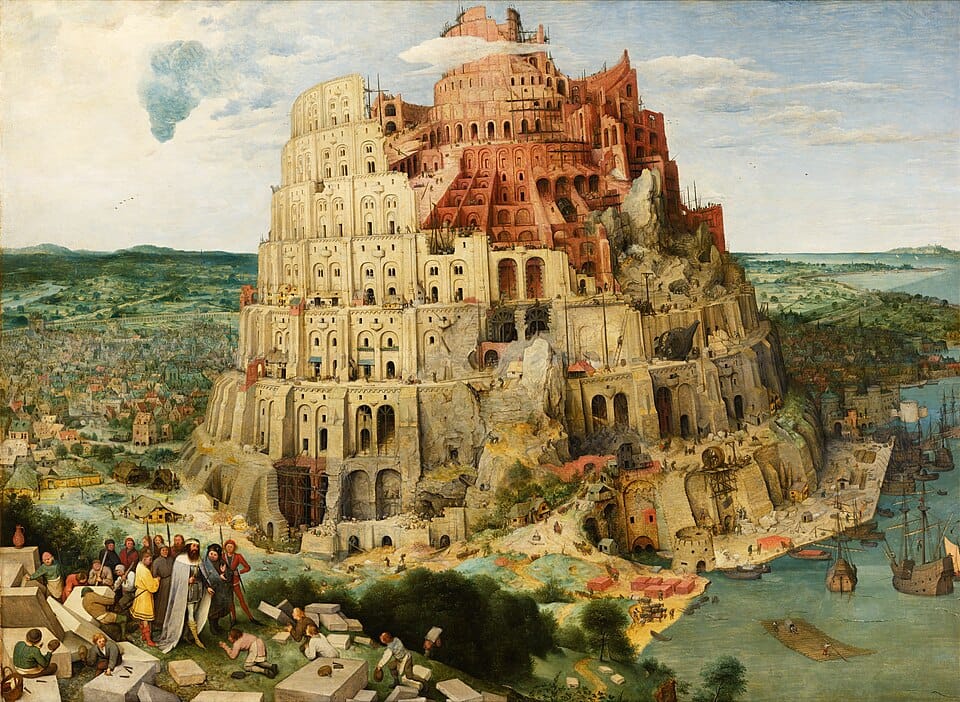
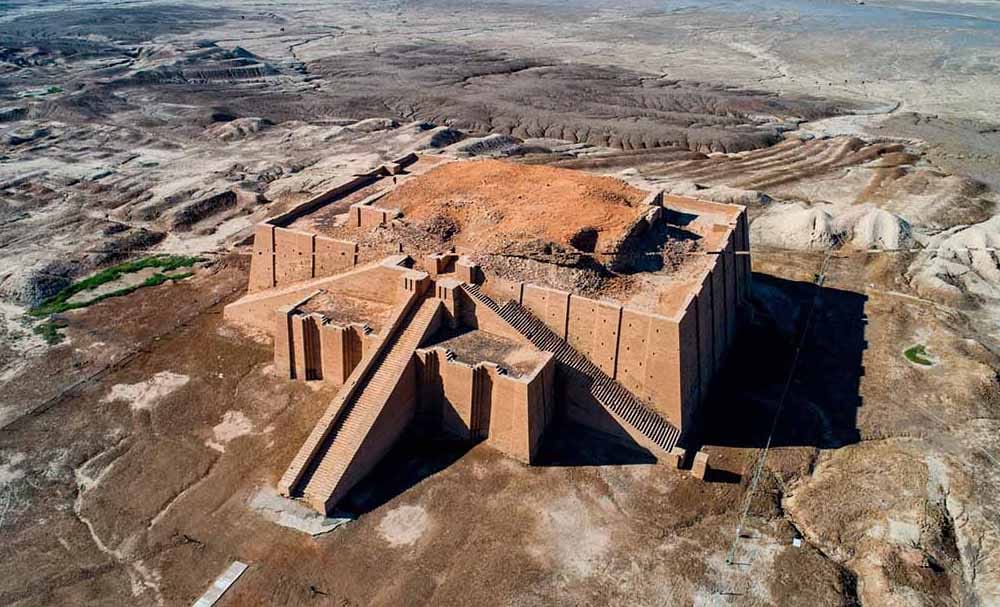
Babel is the next strategy. Not biological this time but civilisational — a coordinated attempt to "make a name for ourselves" (Genesis 11:4), to reach heaven through human engineering, to achieve ascent without the Creator. The tower is the prototype of every subsequent attempt to build a bridge between earth and heaven by human means — technological transcendence without theological submission. God scatters the languages. The strategy is countered. But the pattern is established: what the Watchers attempted biologically, Babel attempts technologically. Corrupt the image-bearer. Degrade the imago Dei. Offer "you will be like God" (Genesis 3:5) through a mechanism that bypasses the God whose image you bear.
The pattern runs unbroken to the present — and if you've been reading my other essays, you'll recognise the convergence. Genetic modification (CRISPR, germline editing) is the Watcher incursion's civilisational successor — altering the biological substrate of the image-bearer at the code level, rewriting the genome the Creator specified. Brain-computer interface is the tower of Babel updated — a direct bridge between human consciousness and artificial superintelligence, merging the image-bearer with a system that is not made in God's image. Daniel 2:43 describes the terminal civilisation as iron mixed with clay — "they will mingle with the seed of men, but they will not hold together" — human and non-human fused but unstable, the same biological-technological hybrid the Watchers attempted, now achieved through silicon rather than angelic flesh. The transhumanist promise — enhanced cognition, extended lifespan, merged consciousness — is Genesis 3:5 in technical vocabulary: "you will be like God, knowing good and evil." The tree of knowledge offered through a neural interface. The forbidden fruit delivered via fibre optic.
And the UAP phenomenon — now officially acknowledged by the United States government through AARO disclosures, congressional hearings, and Pentagon reports confirming objects exhibiting characteristics beyond known technology — represents the ontological dimension of the same incursion. The sons of God descended to Mount Hermon before the flood. The same category of entities — or entities operating under the same authority structure — are presenting themselves again, in forms the modern world can process. Not as gods demanding temples (the ancient strategy, now culturally implausible) but as advanced intelligences offering technological partnership (the modern strategy, culturally irresistible). The "strong delusion" of 2 Thessalonians 2:11 — sent after the gap closes — provides the naturalistic framework: a non-divine explanation for the disappearances, a non-theological context for the covenant, a narrative that makes the Beast's authority plausible without requiring anyone to acknowledge the God whose authority the Beast counterfeits. The golden calf took many forms across history — carved wood, imperial cult, philosophical abstraction. In 2026, it takes the form of artificial superintelligence promising godlike knowledge and UAP disclosure promising cosmic context. A god you can see. A salvation you can engineer. The oldest lie in the newest packaging.
After the flood, a signal is embedded in the genealogy of Genesis 5. Ten names, ten Hebrew meanings: Adam (Man), Seth (Appointed), Enosh (Mortal), Kenan (Sorrow), Mahalalel (The Blessed God), Jared (Shall come down), Enoch (Teaching), Methuselah (His death shall bring), Lamech (The despairing), Noah (Rest). Read sequentially: Man is appointed mortal sorrow, but the Blessed God shall come down, teaching that His death shall bring the despairing rest. The gospel, encoded in a genealogy, visible only from outside time — a block universe signature no human genealogist could have engineered across ten generations of naming.
The nations multiply after the flood, rebel at Babel, and are assigned to the sons of God (Deuteronomy 32:8-9). The assignment corrupts. The overseers become the pantheons. Psalm 82 is the accountability hearing for that specific assignment: "How long will you judge unjustly?" The corrupted overseers are sentenced. "You shall die like men."
The direct testimony chain from the creation is remarkably short. Adam lived 930 years; Lamech (Noah's father) overlapped with Adam by 56 years; Shem, Noah's son, lived 600 years — possibly alive during Abraham's lifetime. Three or four links of personal testimony stretch from Eden to the patriarchs. The nations knew God — from direct witness, not distant rumour. Romans 1:18-32 describes what they did with that knowledge: exchanged the glory for images. Three progressive surrenders — body, desire, mind. The principalities replaced the testimony with their own self-portraits. Three hundred flood narratives worldwide are the residual signal they could not erase.
II. The Carrier
Genesis 12:1-3. The Abrahamic covenant. Five dimensions: separation from principality territory ("Go from your country"), nation formation as resilient carrier ("I will make you a great nation"), blessing as operational capacity ("I will bless you"), protection clause ("whoever curses you I will curse" — this explains antisemitism as strategic attack on the carrier), and universal scope ("in you all the families of the earth shall be blessed").
The universal scope is critical. Abraham is not called for Abraham's sake. Israel is not formed for Israel's sake. The carrier exists for the signal. The signal is for the nations. Every family on the Deuteronomy 32 roster is on the delivery list.
Genesis 15: the covenant ratification. Abraham prepares the sacrifice — animals cut in two, pieces arranged opposite each other. In ancient Near Eastern treaty practice, both parties walk between the pieces, signifying "may this be done to me if I break the covenant." Abraham falls into a deep sleep. A smoking fire pot and a flaming torch — the theophanic fire, the signature of the Logos — pass between the pieces alone. The covenant is unilateral. The penalty falls entirely on the oath-maker. This IS the cross in Genesis 15.
Genesis 22: Mount Moriah. Abraham raises the knife over Isaac. The Angel of YHWH calls from heaven: "Do not lay your hand on the boy." A ram is provided — the substitute. And the ambiguity in Genesis 22:8: "God will provide himself the lamb." The Hebrew supports two readings: "God will provide for himself a lamb" and "God will provide himself as the lamb." The first is what Abraham means. The second is what actually happens — not on this mountain, not on this day, but on this same mountain, two millennia later, when the Logos who is both the one who provides and the one who is provided hangs on a cross at Calvary. Moriah is the mountain where Solomon will build the Temple. Moriah is the mountain where the Messiah will be crucified. The same mountain across three covenants — Abrahamic, Davidic, New. The geography is the theology.
At Sinai, the covenant acquires its operational structure. The law is the paidagogos — the guardian (Galatians 3:24) — that preserves the carrier's distinctiveness until the seed arrives. Deuteronomy is structured as a suzerainty treaty. Heaven and earth are the witnesses (Deuteronomy 30:19).
Then the meal. Exodus 24:9-11: "Moses and Aaron, Nadab and Abihu, and the seventy elders of Israel went up, and they saw the God of Israel. Under His feet there was something like a pavement of sapphire, as clear as the sky itself. Yet He did not stretch out His hand against the nobles of Israel; they saw God, and they ate and drank." They saw God. And they ate and drank. Not destroyed. Not consumed. Fed. The most intimate communion possible — a shared meal in the visible presence of the God of Israel. This is the Kingdom Passover previewed. The arc runs: Sinai meal (Exodus 24) → Last Supper (the vow, Matthew 26:29) → Kingdom Passover (the fulfilment, Nisan 14, 2034). Three meals. Same God. Same table. The first, under the old covenant, on the mountain. The second, transitional, in the upper room. The third, under the new covenant, in the Holy of Holies. And what they saw at Sinai — the sapphire pavement, the radiance, the glory — they saw through the mediation of the Son, who makes the invisible Father visible. "No one has seen God" (John 1:18). Yet they "saw the God of Israel." The resolution: it is the Son's face they see. The Logos making the Father accessible without the Father's direct being being exposed.
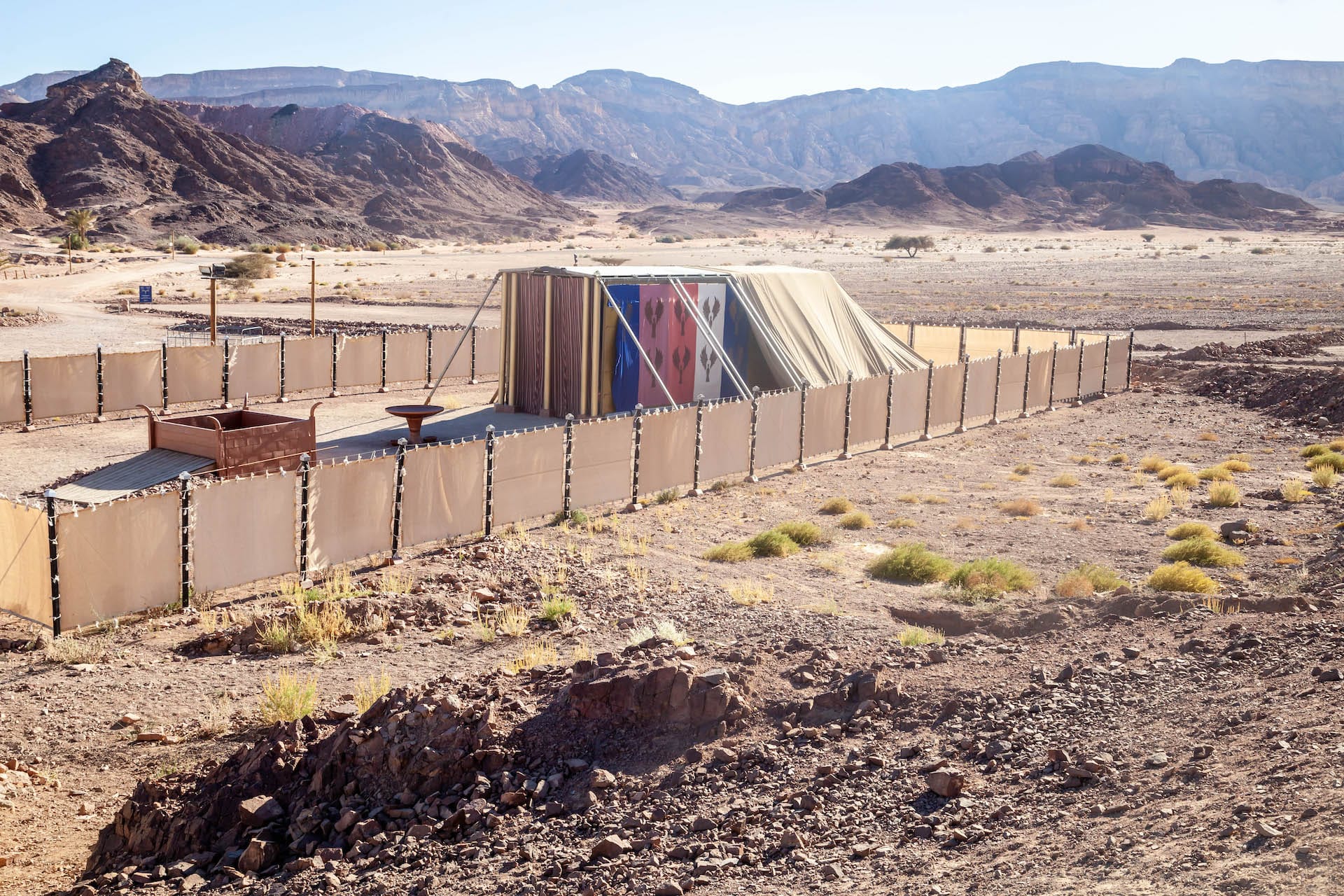
The Tabernacle is Eden rebuilt under controlled conditions after expulsion. Four coverings tell the gospel from outside in: a plain exterior (the kenosis previewed — ordinariness concealing glory), blood-soaked ram skins (the cost of atonement), goat hair (the sin offering), and the innermost layer — cherubim woven into fine linen (the boundary guardians restored to their proper function). The Ark of the Covenant is wood overlaid with gold — humanity and divinity joined in one object. The mercy seat between the cherubim is the throne: "From above the mercy seat, from between the two cherubim, I will speak with you" (Exodus 25:22). The Logos at centre, flanked by the witness pair — the same configuration that appears at Mamre, in Daniel 8, at the tomb, at the ascension.
Exodus 33:18-23. Moses asks to see the glory. YHWH says: "You cannot see my face, for man shall not see me and live." He places Moses in the cleft of the rock and passes by, showing His back. The Father's face remains hidden because the Son IS the face of the Father — "whoever has seen me has seen the Father" (John 14:9). The Father's "back" is what Moses could bear. The Father's "face" is what the Son reveals. The Son is the visible presence of the invisible God. Every theophany in the Hebrew canon is the Logos making the Father accessible — and the day is coming when there will be no cleft, no veil, no mediation. "They will see His face" (Revelation 22:4).
The Tabernacle initiates the progressive reopening of the intersection: Eden (open) → Tabernacle (controlled) → Temple (permanent) → Incarnation (embodied) → Cross (veil torn) → Pentecost (distributed) → New Jerusalem (total). The cube of the Holy of Holies (1 Kings 6:20) expands to the cube of the New Jerusalem (Revelation 21:16) — same geometry, different scale.
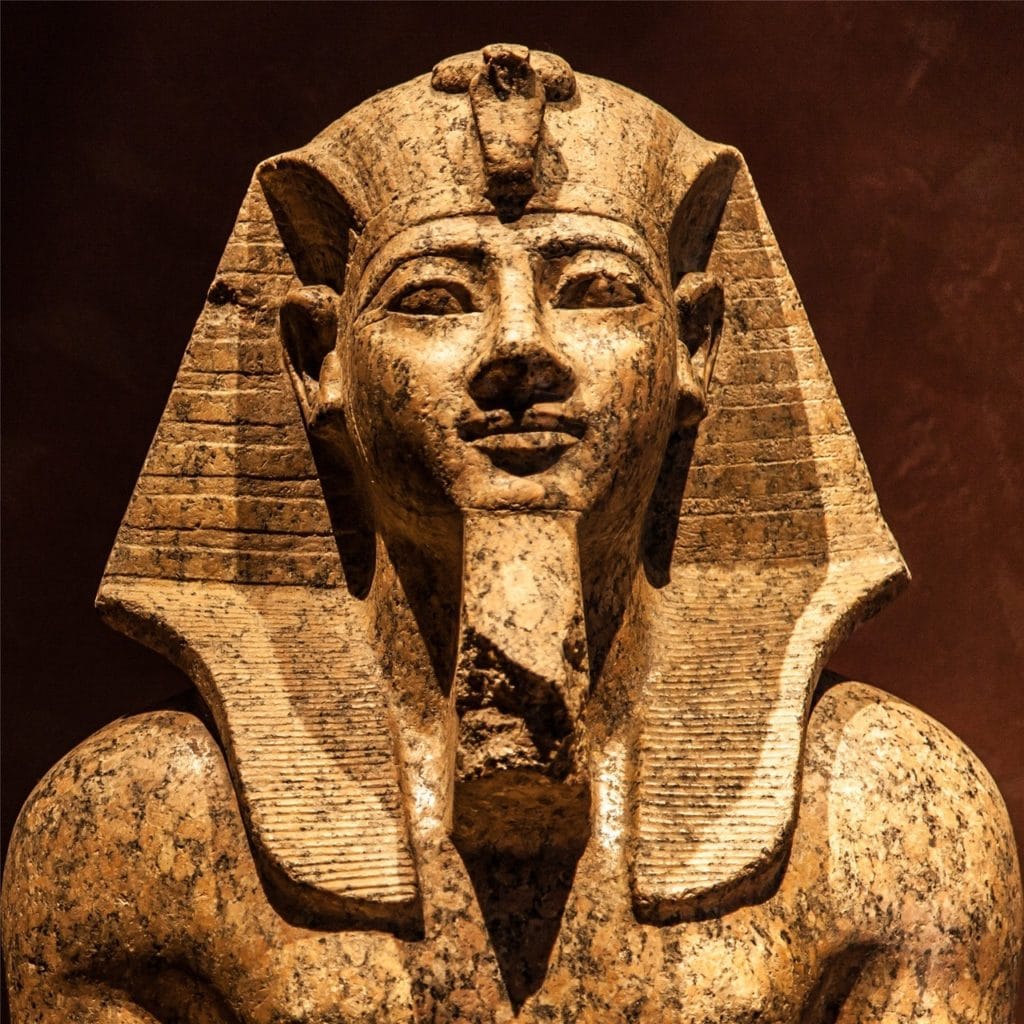
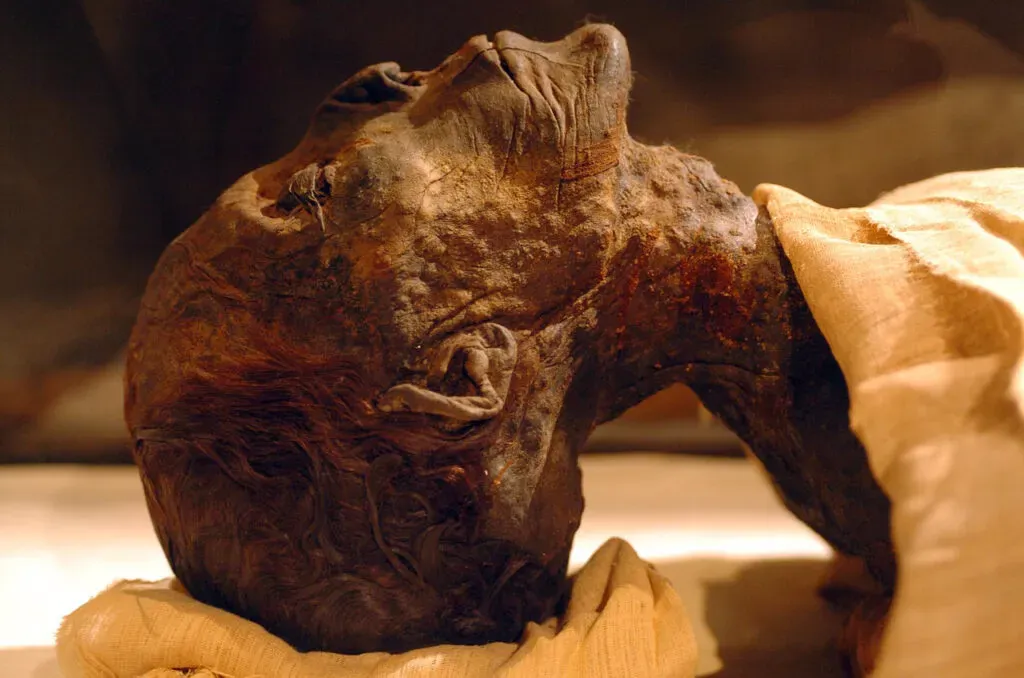
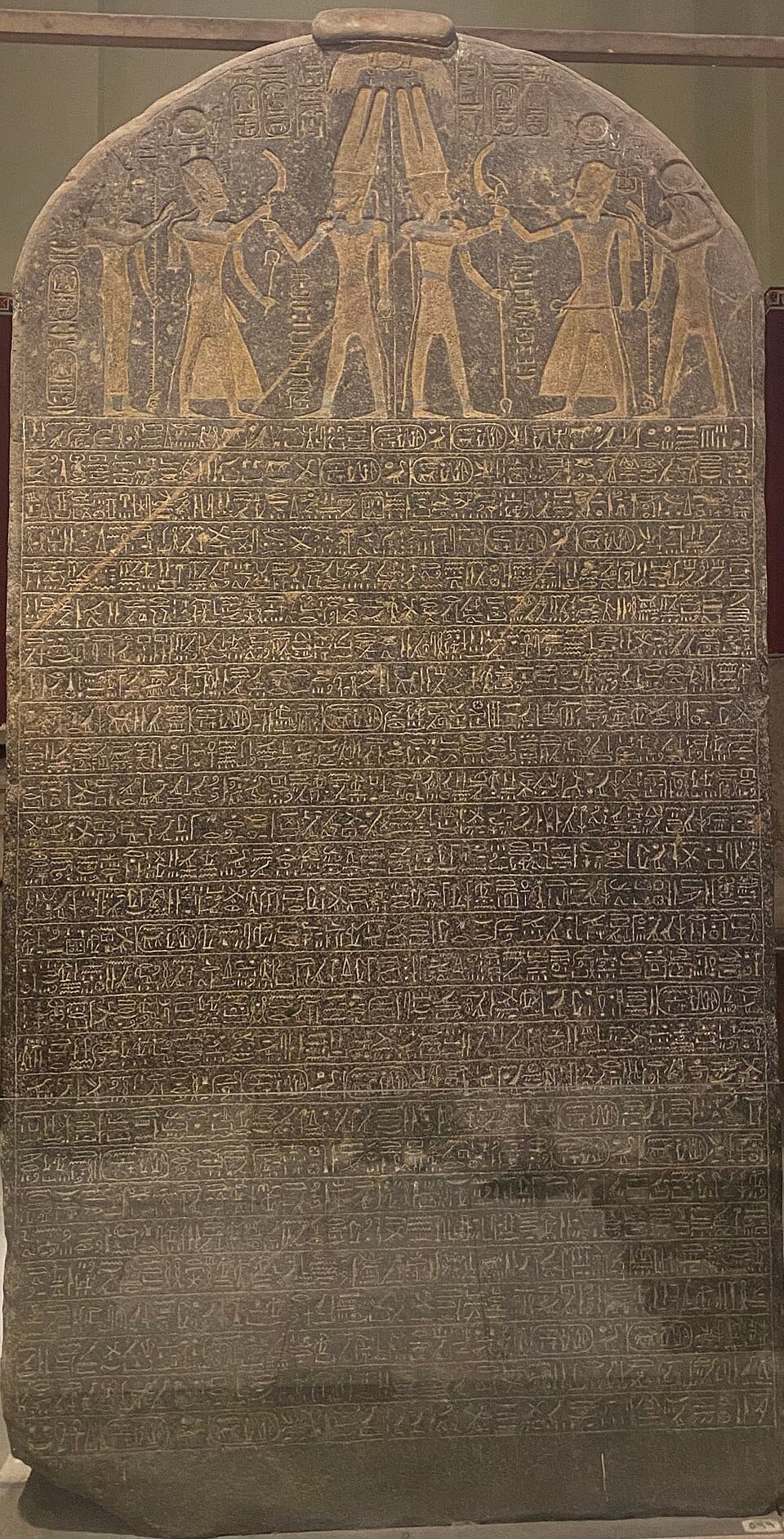
The carrier's history is not a theological abstraction. It is archaeologically grounded. The Soleb inscription — from the temple of Amenhotep III in Sudan, c. 1400 BCE — is the earliest known reference to YHWH outside the Bible: "the land of the Shasu of YHW." YHWH worship predates the Exodus narrative and connects to the region around Midian and Sinai, exactly where Moses encountered the burning bush. The early date for the Exodus (c. 1446 BCE, per 1 Kings 6:1) places Amenhotep II as the Pharaoh — and his reign shows the anomalies the Exodus would predict: a military campaign into Canaan in his ninth year that records capturing, among others, 3,600 Apiru (a term some scholars connect to "Hebrew"), followed by a conspicuous absence of further campaigns and a co-regency suggesting dynastic crisis. The Merneptah Stele — c. 1208 BCE, the earliest extra-biblical reference to Israel as a people — records "Israel is laid waste; his seed is no more," confirming Israel's existence in Canaan within two centuries of the Exodus. The carrier's presence in the land is not inferred from theology. It is inscribed in stone by Israel's enemies.
The Song of Moses — Deuteronomy 32 — compresses the entire covenant arc into a song. The Rock whose work is perfect. Jeshurun growing fat and kicking. "I will make them jealous with those who are no people" (the Gentile inclusion — Paul quotes this in Romans 10:19). "YHWH will vindicate his people when he sees that their power is gone" (the restoration at exhaustion — Zechariah 12:10 at Yom Kippur 2033). "See now that I, even I, am He; I kill and I make alive" — Ehyeh, the cross and the resurrection in one verse. And YHWH lifts His hand to heaven and swears — "As I live forever" — the same gesture the Palmoni makes in Daniel 12:7. Revelation 15:3: "They sing the song of Moses and the song of the Lamb." Both songs. Same song.
III. The Throne
The covenant narrows at every generation to the unexpected son — the Selector's signature. Abraham → Isaac (not Ishmael). Isaac → Jacob (not Esau). Jacob → Judah (not Reuben the firstborn, not Joseph the favourite). Judah → David (the youngest, forgotten in the field). David → Jesus (virgin birth navigating the Jeconiah curse).
2 Samuel 7: the Davidic covenant. David wants to build God a house. God reverses it: "I will build you a house." Three promises — house, throne, kingdom — all "forever." And: "I will be his Father, and he shall be my Son." Psalm 2:7 amplifies: "You are my Son; today I have begotten you." Psalm 45:6-7 escalates: God addresses the king as God — "Your throne, O God, is forever." Hebrews 1:8 applies this directly to Jesus.
Then Jeremiah 22:30 — the Jeconiah curse: no physical descendant of Jeconiah will sit on David's throne. Two constraints, one key. Legal claim through Joseph's line (Matthew 1, through Solomon and Jeconiah). Biological descent through Mary's line (Luke 3, through Nathan, bypassing Jeconiah). Isaiah wrote "a virgin shall conceive." Jeremiah wrote the curse. Neither coordinated. Exactly one configuration satisfies both.
The theophanic presence tracks the covenant's status through the monarchy. The glory fills Solomon's Temple (1 Kings 8:10-11). Isaiah sees the Lord enthroned — "high and lifted up, the train of his robe filling the temple" (Isaiah 6:1-4). The seraphim sing the trisagion. And John 12:41 makes the identification explicit: "Isaiah said these things because he saw his glory and spoke of him" — referring to Jesus. Isaiah saw the Son. Enthroned. In the Temple. The glory that would depart and return.
The Davidic monarchy is not a literary fiction. The Tel Dan Stele — discovered 1993, dated c. 840 BCE — is an Aramean victory inscription that references "the house of David," the earliest extra-biblical confirmation of David's dynasty. Royal bullae — clay seal impressions — of biblical kings have been recovered archaeologically: Hezekiah ("Belonging to Hezekiah son of Ahaz, king of Judah"), Jeroboam II, and officials named in the biblical text. The Babylonian Chronicles confirm the siege and fall of Jerusalem in 586 BCE and Nebuchadnezzar's deportation of Jehoiachin — the same Jeconiah whose curse constrains the Messiah's genealogy. The Cyrus Cylinder confirms the Persian decree authorising the return from exile. The carrier's political history is verified by the carrier's enemies.
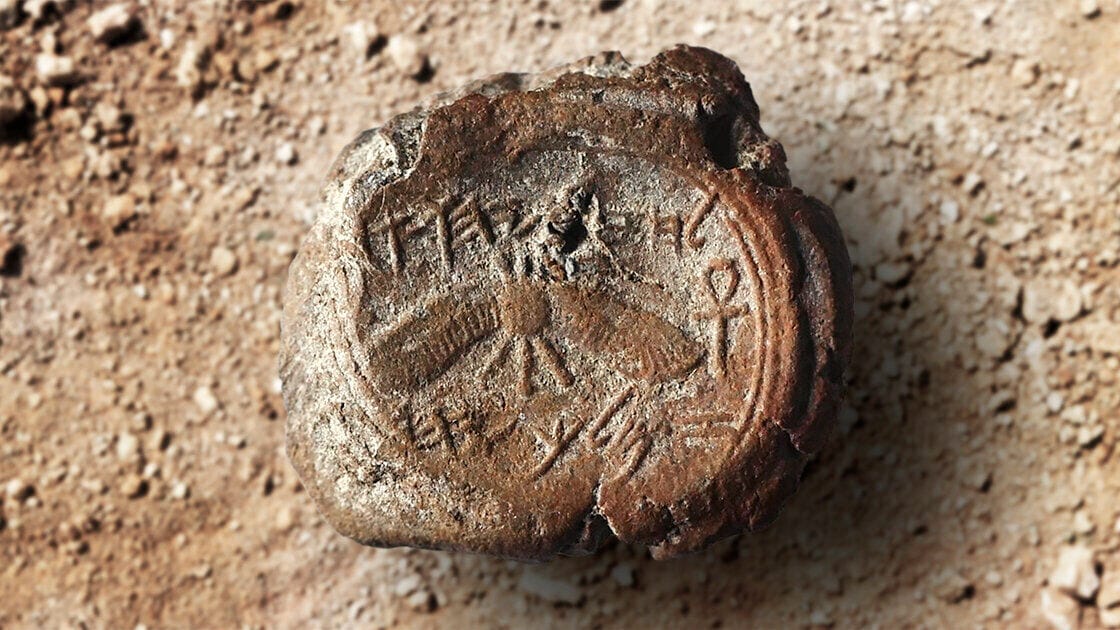
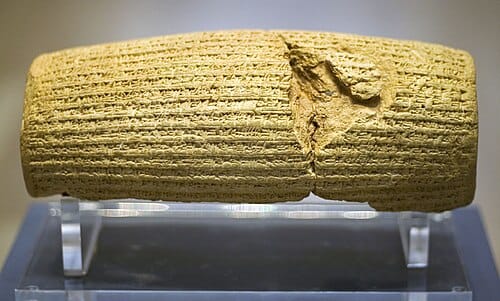
Then the kings corrupt the Temple. Ezekiel watches the kavod lift from the mercy seat, move to the threshold, pause at the east gate, and depart to the Mount of Olives (Ezekiel 10-11). The departure point IS the return point: Zechariah 14:4. The glory will return to the mountain from which it departed — at the coordinates the chiasm computes.
Haggai 2:9: "The glory of this present house will be greater than the glory of the former house." The Second Temple has no Ark, no shekinah, no sacred fire. The rabbis acknowledged five things absent that were present in the First. Yet Haggai says the latter glory exceeds the former. Because the latter house is the house the Logos enters in person. Jesus walking into the Second Temple IS the fulfilment. The Archetype in the ectype's form.
Jeremiah 25:11 predicts seventy years of exile. Daniel, reading Jeremiah in Babylon, understands the timeframe is expiring. He prays. Gabriel arrives with the 70-weeks prophecy — the master timeline encompassing both comings. Jeremiah announces the new covenant: "I will put my law within them, and write it on their hearts" (31:31-34). Jeremiah names the coming king: "YHWH Tsidkenu" — The LORD Our Righteousness (23:5-6). The name is not merely a royal title. It is the cross expressed as a name — the Person who IS YHWH becoming the righteousness OF His people through substitutionary atonement. "God made him who had no sin to be sin for us, so that in him we might become the righteousness of God" (2 Corinthians 5:21). The Davidic branch carries the divine Name and the divine Name carries the mechanism of salvation: YHWH Himself becoming OUR righteousness. The name specifies what the cross achieves — imputed righteousness, the legal transfer of the King's standing to those who have none. And Jeremiah 32 — buying a field during the siege, sealing the deed in a clay jar — is itself a progressive disclosure mechanism: a document sealed for future generations, opened when fulfilment arrives. The pattern of sealed information runs through the entire deposit.
IV. The Portrait
Across four centuries of independent prophetic voices, a composite portrait accumulates — specifications so precise they function as a fingerprint, identifying one historical individual and excluding every other.
Lineage constraints: seed of the woman (Genesis 3:15), seed of Abraham (Genesis 12:3), tribe of Judah (Genesis 49:10), house of David (2 Samuel 7:12-13). Born in Bethlehem (Micah 5:2) — "whose goings forth are from of old, from everlasting," the pre-existence clause embedded in the birth announcement. Born of a virgin (Isaiah 7:14). Called out of Egypt (Hosea 11:1). Ministry in Galilee (Isaiah 9:1-2).
Preceded by a messenger — and Malachi 3:1-4 compresses the entire essay into four verses. "Behold, I send my messenger, and he will prepare the way before ME." YHWH speaking. Before ME — not "before my representative" or "before my anointed." Before ME. The messenger prepares for YHWH Himself. John prepares for Jesus. Therefore Jesus IS YHWH — the identification is explicit in the grammar. "And the Lord whom you seek will suddenly come to HIS temple." The temple belongs to Him. He is the Owner. The visitation. "And the messenger of the covenant in whom you delight" — a third figure alongside the messenger (John) and the Lord (the Son). Three figures in one verse.
But then: "Who can endure the day of his coming, and who can stand when he appears?" The question is not rhetorical. It is structural. The answer is: no one — at the first coming, the coming is for purification, not enthronement. "He is like a refiner's fire and like fullers' soap. He will purify the sons of Levi and refine them like gold and silver." The priesthood is purified — not abolished but refined. And the result: "Then the offering of Judah and Jerusalem will be pleasing to the LORD as in the days of old and as in former years." This has not happened yet. The Yoma 39b signs proved the offerings were NOT pleasing for forty years before the Temple's destruction. The pleasing offerings "as in the days of old" point forward — to the millennial Temple of Ezekiel 40-48, where the purified sons of Levi offer memorial sacrifices in righteousness under the King's direct presence. Malachi 3:1-4 spans both comings in four verses: the forerunner preparing, the Lord arriving at His Temple (first coming), the purification through suffering (the cross), and the restored offerings under the returned King (second coming). The entire two-phase architecture in a single passage from the last Hebrew prophet — followed by four hundred years of silence.
Isaiah 40:3-5 specifies the forerunner's operational mandate: "Prepare the way of YHWH." Not a prophet. Not a messenger. YHWH. The voice prepares the way for YHWH Himself. The implication is the identification.
The ontological specifications: Psalm 2's Son of God, heir of nations, object of refuge — a divine prerogative. The Aramaic bar connecting to Daniel 7:13's Son of Man. Psalm 110: "The LORD said to my Lord" — two YHWHs, and the king is priest forever after Melchizedek's order. Isaiah 9:6: a child named Mighty God, Everlasting Father. Jeremiah 23:5-6: the Davidic Branch called "YHWH Our Righteousness."
The entry: Zechariah 9:9 — "Your king comes to you, righteous and having salvation, lowly and riding on a donkey." The king comes humble. The kenosis encoded in the entry method. Donkey at the first coming (humility). White horse at the second (Revelation 19:11 — glory). Same king. Different modes. The two-phase pattern visible in the manner of arrival.
The Servant Songs trace the mission across four movements. Isaiah 42: the Servant IS the covenant and IS the light to nations. Isaiah 49: "Too small a thing to restore the tribes of Jacob" — the scope exceeds Israel, the signal is for the nations. Isaiah 50: voluntary suffering. Isaiah 52:13-53:12: the full weight — pierced, crushed, bearing iniquity, making many righteous. Then vindication: offspring, long days. Death followed by continued life.
Psalm 22 — the crucifixion from the inside. "My God, my God, why have you forsaken me?" — the opening line Jesus quotes from the cross, directing his audience to the entire psalm. "All who see me mock me; they hurl insults, shaking their heads: 'He trusts in the LORD; let the LORD rescue him'" (22:7-8) — the mockery at Calvary scripted a millennium before it happened. "They pierced my hands and my feet" (22:16) — written centuries before crucifixion existed as a method of execution. "They divide my garments among them and cast lots for my clothing" (22:18) — fulfilled at the cross (John 19:23-24). The psalm describes the crucifixion from the victim's internal experience, in a culture that did not practice crucifixion, a millennium before Rome existed. And the psalm does not end in despair. It ends in triumph: "All the ends of the earth will remember and turn to the LORD, and all the families of the nations will bow down before him" (22:27). The suffering produces universal worship. The nations are included through the death.
The three anointed offices converge: Prophet (Deuteronomy 18:15), Priest (Psalm 110:4 — Melchizedek order), King (Psalm 2:6). These map onto the Trinitarian operations: Prophet corresponds to formation — introducing the word, opening conceptual space. Priest corresponds to introduction — specifying the sacrifice, mediating between God and man. King corresponds to β-reduction — actualising the rule. The offices were kept separate in Israel because they are dangerous in fallen hands. The Hasmoneans combined them; the result was corruption. They converge safely only in the Person who is not fallen.
The specificity of the accumulated portrait — over forty independent specifications across lineage, temporal, birth, ministry, betrayal (Psalm 41:9, Zechariah 11:12-13 — thirty pieces of silver), death, resurrection (Psalm 16:10), ascension (Psalm 68:18), return — yields a probability of accidental fulfilment in the range of 10^-17 to 10^-157. The portrait is not a vague outline. It is a forensic composite matching one face.
V. The Two Portraits
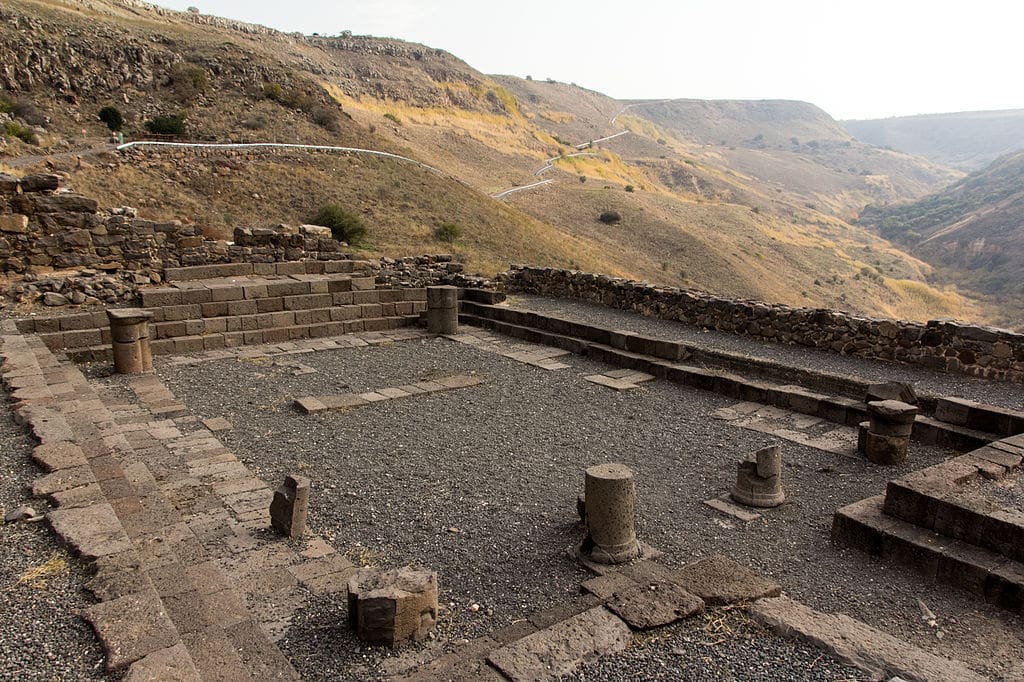
Here's the problem the first century faced — and it's the problem most people still face when they encounter the messianic claim.
The prophetic deposit contains two sets of specifications that appear irreconcilable.
One portrait is the suffering servant. Pierced for our transgressions (Isaiah 53:5). Cut off from the land of the living (53:8). Despised and rejected (53:3). Silent before his accusers (53:7). Hands and feet pierced (Psalm 22:16). Garments divided by lot (22:18). Betrayed by a close friend for thirty pieces of silver (Psalm 41:9, Zechariah 11:12-13). Buried with the rich (Isaiah 53:9).
The other portrait is the conquering king. Enthroned on Zion with the nations as his inheritance (Psalm 2:7-9). Reigning forever on David's throne with no end to the increase of his government (Isaiah 9:6-7). The sevenfold Spirit resting on him, the wolf dwelling with the lamb, the earth full of the knowledge of the LORD as the waters cover the sea (Isaiah 11:1-10). Swords beaten into ploughshares, nations no longer training for war (Isaiah 2:2-4, Micah 4:1-4). All peoples and nations and languages serving him, his dominion everlasting (Daniel 7:14). The whole earth filled with his glory, all nations calling him blessed (Psalm 72). YHWH king over the whole earth, one LORD and his name the only name (Zechariah 14:9). A covenant of peace, the sanctuary among them forever, God's dwelling place with them (Ezekiel 37:24-28). New heavens and new earth, no more infant death, no more weeping (Isaiah 65:17-25). David's fallen shelter restored, Israel planted in their own land never again to be uprooted (Amos 9:11-15).
These two portraits — suffering and reigning, rejected and enthroned, cut off and ruling forever — cannot be satisfied by one event. And this is precisely where Israel's reading and the principalities' strategy converge. The principalities' play was to amplify the kingly specifications and suppress the suffering ones. The result: first-century Israel expected a warrior king who would overthrow Rome, restore the Davidic throne, and establish the kingdom immediately. When a suffering servant arrived instead — teaching in parables, healing the sick, dining with sinners — the expectation mismatch became the mechanism of rejection. Israel was not wrong to expect a king. Israel was wrong to expect only a king.
The resolution is two comings. The first satisfies the suffering specifications. The second satisfies the triumphant ones. The same Person. Two vertices of the same geometric structure, separated by the gap — the Church age, the time of the Gentiles — during which the signal reaches the nations.
Jesus himself made this two-phase pattern explicit. Luke 4:18-20: he reads Isaiah 61 in the synagogue at Nazareth — "The Spirit of the Lord is on me, because he has anointed me to proclaim good news to the poor... to proclaim the year of the LORD's favour" — and stops mid-sentence. He rolls up the scroll and says "Today this Scripture is fulfilled in your hearing." But the Isaiah 61 passage continues: "and the day of vengeance of our God." He read the favour clause. He stopped before the vengeance clause. The favour belongs to the first coming. The vengeance belongs to the second. He divided the verse at the comma. The comma is the gap.
The Olivet Discourse — Matthew 24-25 — is Jesus' own mapping of the triumphant prophecies to the second coming. The abomination of desolation (the chiasm's midpoint, Matthew 24:15). The great tribulation (the second half of the 70th week, 24:21). The cosmic signs — sun darkened, moon not giving light, stars falling (24:29) — matching the eclipse and meteor shower of August 2026. And then: "They will see the Son of Man coming on the clouds of heaven with power and great glory" (24:30). Daniel 7:13 fulfilled. The fig tree parable placing the generational limit (24:32-34). The ten virgins specifying readiness (25:1-13). The sheep and goats specifying the judgment of the nations (25:31-46). Jesus himself mapped the triumphant specifications to the second vertex and described what the transition looks like.
Every triumphant prophecy Israel expected is delivered — not at the first coming but at the second. The eternal Davidic reign (Isaiah 9:7) begins when the glory returns to the Temple. The creation renewal (Isaiah 11, 65) proceeds when the current groaning boundary is replaced by the new specification. The universal peace (Isaiah 2, Micah 4) is established when the principality administration of the nations ends — the corrupted overseers judged (Psalm 82's sentence executed), the nations no longer set against each other by territorial powers competing for worship. The reversal of Babel — the nations reunited under direct divine sovereignty, the scattering undone, the tongues of Pentecost previewing the reunification the kingdom completes. The Abrahamic promise reaching full scope through the Davidic king (Psalm 72). Zechariah 14:9 — one LORD over the whole earth. Ezekiel 37:24-28 — the everlasting covenant of peace. The covenant formula reaching its final occurrence: "I will be their God, and they will be my people." Revelation 21:3 quotes it: "God's dwelling place is now among the people." And Amos 9:11-15 — David's tent restored — cited by James at the Jerusalem Council (Acts 15:16-17) as the basis for including the Gentiles. The restoration of David's shelter IS the mechanism by which the nations are reached. The triumphant prophecies and the nations' inclusion are not competing agendas. They are the same agenda, delivered at the coordinate the Diamond Chiasm computes.
The kingly Messiah Israel expected is the same Person as the suffering servant Israel rejected, arriving at the second vertex to do what the first-century crowd wanted him to do at the first — but only after the atonement the first vertex accomplished makes the kingdom possible. Without the cross, there is no basis for the kingdom. Without the kingdom, the cross has no terminus. The two portraits are one portrait, painted on two canvases, separated by the gap, converging at coordinates now computing.
VI. The Bridge
The four hundred years between Malachi and John are not silent theologically. The deuterocanonical literature fills the gap with a crescendo of messianic expectation that demolishes the claim that divine Christology was a later Christian invention. Daniel Boyarin — an Orthodox Jewish scholar at Berkeley — published the argument that the divine, suffering Messiah was a pre-Christian Jewish expectation. The evidence supports him.
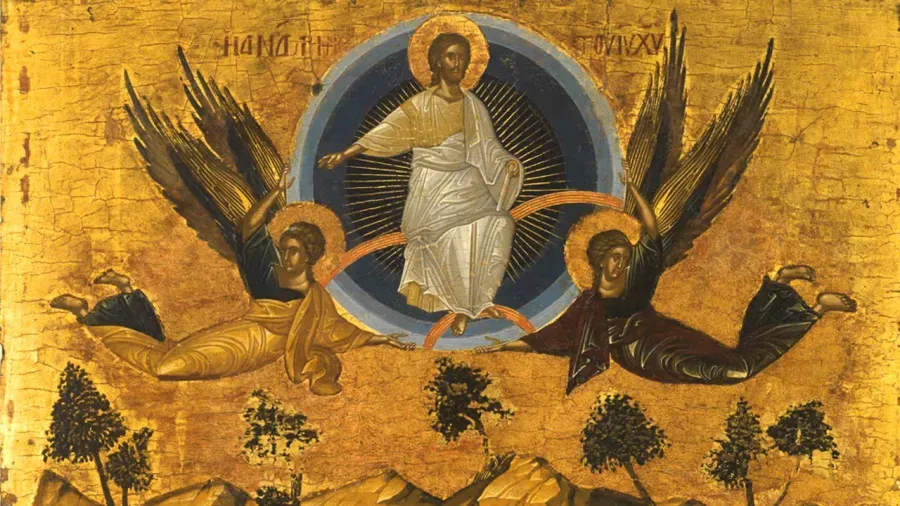
1 Enoch: The Hidden Son of Man. The Parables (1 Enoch 37-71), dated pre-Christian by near-unanimous consensus at the 2005 Enoch Seminar, are the most developed treatment of the Messiah's pre-existence.
1 Enoch 48:2-3: "Before the sun and the constellations were created, before the stars of heaven were made, his name was named before the Lord of Spirits." Named before creation. The Messiah's identity established in the divine council before the physical universe exists. 1 Enoch 48:6: "Chosen and hidden in His presence before the world was created, and forever." The Son of Man exists within the perichoresis — hidden in the Father's presence — revealed at the appointed coordinate.
1 Enoch 46: two figures. The Head of Days — white hair like wool — is the Ancient of Days from Daniel 7:9. The second has "the appearance of a man." Enoch asks "who he was, and whence he was." The pre-existence passages answer: he was with the Head of Days before the world existed.
1 Enoch 51:3: "The Elect One shall sit on the throne of glory." On it. The divine throne. 1 Enoch 61:8: the Elect One judges the holy ones — the angelic hierarchy subject to his judgment. Cosmic sovereignty. Four titles converge in one figure: Son of Man (Daniel 7 — cosmic), Elect One (Isaiah's Servant — suffering), Messiah (Davidic — royal), Righteous One (Isaiah 53:11 — justifying). The synthesis Christianity is accused of inventing was already present in a pre-Christian Jewish text.
1 Enoch 62:7: "From the beginning the Son of Man was hidden, and the Most High revealed him to the elect." The concealment-revelation pattern: pre-existence, hiddenness, selective disclosure. This matches Jesus' practice exactly — parables, the messianic secret, progressive revelation to those prepared to receive it.
The Dead Sea Scrolls. 11Q13 calls Melchizedek "Elohim," assigns him eschatological atonement on Yom Kippur, applies Daniel 9:25 to a divine figure. 4Q521 provides the messianic checklist: "heal the wounded, revive the dead, bring good news to the poor." Jesus recites this list as his credential (Matthew 11:4-5).
4 Ezra. The Man from the Sea (13:1-4) emerges from the primordial deep — the tehom of Genesis 1:2 — and flies with the clouds. Pre-cosmic origin. 4 Ezra 13:26: "He whom the Most High has been keeping for many ages, who will himself deliver his creation." His creation. The language of an owner. And 4 Ezra 7:28-29: "My Son the Messiah shall die." A pre-Christian Jewish text explicitly stating the Messiah will die.
2 Baruch. The Messiah "begins to be revealed" (29:3) — progressive disclosure. Then: "He shall return in glory" (30:1). Two comings present in a Jewish apocalypse independent of Christian theology.
The Wisdom Tradition. The trajectory runs from pre-existence to incarnation. Proverbs 8:22-31: Wisdom set up from everlasting, beside God as a master workman at creation. Sirach 24:3-8: "I came forth from the mouth of the Most High... Make your dwelling in Jacob." Wisdom pitches her tent in Israel — the tabernacle language John will use for the incarnation (eskēnōsen, John 1:14). Wisdom of Solomon 7:25-26: "A breath of the power of God, a pure emanation of the glory of the Almighty, a reflection of eternal light, an image of his goodness." Every phrase maps onto New Testament Christology (Hebrews 1:3, Colossians 1:15).
Wisdom 2:12-20 scripts the crucifixion a century early. The righteous one "calls himself a child of the Lord." His opponents: "Let us condemn him to a shameful death, for, according to what he says, he will be protected." Compare Matthew 27:43: "He trusts in God; let God deliver him now." Word for word. And Wisdom 5:1-5 — the vindication: "This is the one we once held in derision... Why has he been numbered among the children of God?" Zechariah 12:10 in narrative form. Wisdom 18:14-16: "Your all-powerful word leapt from heaven, from the royal throne, a stern warrior carrying the sharp sword of your authentic command." The Logos as warrior — Revelation 19:13-15 anticipated. Baruch 3:37: "Afterward she appeared on earth and lived with humankind." The incarnation in a pre-Christian Jewish text.
Philo of Alexandria. Contemporary of Jesus. Devout Jew. Calls the Logos "the image of God" and "the eldest son." In De Fuga 101: "the second God." A Jewish thinker calling the Logos a second God — the same "two powers in heaven" tradition Segal documents and the rabbis will later suppress.
The Talmud. Pesachim 54a: the Messiah's name among seven things created before the world. Genesis Rabbah 1:4: "The spirit of God hovered over the face of the waters — this is the spirit of King Messiah." Sanhedrin 98b: the leper scholar as Messiah, citing Isaiah 53:4. Ruth Rabbah 5:6: Isaiah 53:5 applied to an individual Messiah, "deprived of sovereignty for a time." Pesikta Rabbati 36-37: seven years of voluntary messianic suffering, and through that suffering "not one of Israel shall perish" — voluntary substitutionary atonement in a rabbinic source. Yoma 39b: forty years before the Temple's destruction (~30 CE), the Temple signs stopped — the scarlet thread ceased turning white, the western lamp went out, the Temple doors opened by themselves. Something changed at the crucifixion. The rabbis recorded it without understanding what they recorded.
Antiochus as typological key. Antiochus IV Epiphanes (167 BCE) desecrated the Temple — the abomination of desolation (Daniel 11:31, 1 Maccabees 1:54). The 2,300-day count in Daniel 8:14 first measures Antiochus's desecration before Hanukkah's rededication. The same integer operates at three scales: historical (Antiochus), transitional (70 CE), eschatological (the outer diamond). The historical fulfilment calibrates the pattern. The eschatological fulfilment completes it.
The Maccabees who cleansed the Temple acknowledged they were placeholders. 1 Maccabees 14:41: the people accepted Simon "until a trustworthy prophet should arise." The Psalms of Solomon (c. 50 BCE): "Raise up for them their king, the son of David... their king shall be the Lord Messiah" (17:21, 32). The expectation was fully formed. The Person was approaching.
The rabbis carried the portrait faithfully. They refused to look at the face it depicts. The signal survived in the signal station even when the operators could not hear it.
VII. The Convergence
Stay with me here — because this is where the threads converge, and the density is the point.
The first century is the most over-determined moment in human history. Every thread converges on a thirty-year window.
The convergence is legible through Daniel's empire sequence. Daniel 2 describes a statue — gold head (Babylon), silver chest (Persia), bronze thighs (Greece), iron legs (Rome) — struck by a stone "cut without hands" that becomes a mountain filling the earth. Daniel 7 describes four beasts: lion (Babylon), bear (Persia), leopard (Greece), and a terrifying fourth beast with iron teeth (Rome). The sequence is not allegorical. Babylon fell to Persia in 539 BCE. Persia fell to Alexander in 331 BCE. Alexander's empire fractured into four — the Ptolemaic, Seleucid, Antigonid, and Attalid kingdoms (Daniel 8:8, "four prominent horns"). The Seleucid king Antiochus IV Epiphanes desecrated the Temple in 167 BCE — the historical abomination that calibrates Daniel's integers. The Maccabean revolt followed, producing the Hasmonean dynasty — the only period of Jewish independence between the exile and 1948.
But the Hasmoneans combined the offices of king and priest in one family, violating the Torah's separation. The result was predictable: internal corruption, civil war between the brothers Hyrcanus II and Aristobulus II, and the fatal invitation — both brothers appealed to Rome to arbitrate. Pompey obliged. In 63 BCE, Roman legions entered Jerusalem. The iron legs of Daniel's statue stepped onto Judean soil. Jewish independence ended. The fourth beast had arrived.
Rome installed client kings. Herod the Great — an Idumean, a descendant of Esau — received his throne from the Roman Senate in 40 BCE. An Edomite on the Judean throne: the covenant succession inverted. Genesis 49:10: "The sceptre shall not depart from Judah, nor the ruler's staff from between his feet, until Shiloh comes." Herod IS the sceptre departing. The Talmud records the rabbinic anguish: "Woe unto us, for the sceptre has departed from Judah, and the Messiah has not come!" They did not recognise he had already been born.
Daniel's 69 weeks are expiring simultaneously. 173,880 days from Nisan 1, 444 BCE to Nisan 10, 33 CE. The Danielic computation and the sceptre departure converge in the same generation.
And Herod knows something is wrong. When the Magi arrive asking "Where is the one born king of the Jews?" (Matthew 2:2), his response is terror — because the question implies a legitimate king, which means Herod is not. The massacre of the infants in Bethlehem is the Genesis 3:15 war in real time — the principality behind Herod recognising the seed and striking through his human instrument.
After Herod's death in 4 BCE, Rome divided the territory. Judea and Samaria fell under direct Roman administration — governed by prefects (later procurators), of whom Pontius Pilate (26-36 CE) is the fifth. Galilee remained under Herod Antipas, a tetrarch — the Herod who beheads John the Baptist and mocks Jesus at his trial. The Sanhedrin retains religious authority but loses the right of capital punishment — which is why Jesus must be handed to Pilate for execution. The judicial architecture of the crucifixion is determined by the political structure of Roman provincial administration.
Into this occupied territory, five competing restoration strategies emerge — five answers to the question "How does God deliver Israel under the iron beast?"
The Sadducees are the Temple aristocracy. Priestly families — descendants of Zadok, Solomon's high priest — who control the sacrificial apparatus, the half-shekel tax, the animal trade, and the money-changing monopoly. They collaborate with Rome because the Temple's operation requires Roman permission. They accept only the written Torah (rejecting oral tradition and the prophets' authority on matters of doctrine), deny the resurrection, deny angels and spirits. Their theology is conservative, their politics accommodationist, their economics extractive. The Temple under their administration is architecturally magnificent — Herod's expansion makes it one of the wonders of the ancient world — and spiritually hollow. They are the establishment.
The Pharisees are the lay scholars. They emerge in the second century BCE as a movement devoted to applying Torah to every dimension of daily life — not just Temple ritual but household, marketplace, and table. They develop the "oral Torah" — interpretive traditions they believe Moses received at Sinai alongside the written Torah — building a "fence around the law" to prevent accidental violation. They believe in resurrection, angels, divine providence, and the coming Messiah. They operate the synagogue network — by the first century, some 480 synagogues in Jerusalem alone — bringing Torah study to the common people outside the Temple system. Their devotion is genuine. Their error is systemic: the fence around the law becomes the law. External compliance replaces internal transformation. Jesus' conflicts with the Pharisees are not about Torah itself but about what Torah demands — "mercy, not sacrifice" (Matthew 12:7, quoting Hosea 6:6). They are the closest to the kingdom and the most resistant to recognising the King, because their system works well enough to feel sufficient.
The Essenes have withdrawn. Disgusted by the Hasmonean corruption of the priesthood and the Sadducean collaboration with Rome, they establish communities in the wilderness — most famously at Qumran, overlooking the Dead Sea. Their scrolls — hidden in 68 CE, discovered in 1947 — preserve the most precise messianic texts: 11Q13 (the divine Melchizedek), 4Q521 (the messianic checklist), the War Scroll (the final battle). They expect two Messiahs — a priestly Messiah of Aaron and a royal Messiah of Israel — and a Teacher of Righteousness who will restore the legitimate priesthood. They are the most theologically prepared and the most positionally absent. They miss the Messiah because they are in the desert when he walks through Jerusalem, and because he declares himself the Temple (John 2:19-21) rather than restoring the one they consider polluted.
The Zealots are the militants. They carry the Maccabean memory — the conviction that God fights with the faithful, that armed resistance is the mechanism of deliverance. Judas of Galilee led a revolt against the Roman census in 6 CE, establishing the principle that paying tribute to Caesar is treason against God. The Zealots expect a warrior king who will overthrow Rome by force. Multiple claimants arise — Theudas, the Egyptian, Simon bar Giora — each following the template: military messiah, violent confrontation, death, dispersal. Gamaliel notes the pattern (Acts 5:34-39): if this movement is human, it will fail like the others. The Zealots are right about the Person's identity (king) and wrong about the mechanism (sword instead of cross). Their error drives the Jewish War of 66-73 CE — the war Josephus says was incited by the "ambiguous oracle" from Daniel, the computation that told them the time was right for a deliverer. They were right about the timing. The deliverer had come thirty years earlier. They chose the sword. The sword destroyed them.
The common people — the am ha'aretz, the people of the land — are caught between all factions. Too poor for the Sadducean aristocracy, too uneducated for Pharisaic scholarship, too settled for Essene withdrawal, too cautious for Zealot violence. They are the sheep without a shepherd (Matthew 9:36). They want deliverance — not theological refinement. When Jesus feeds the five thousand, they try to make him king by force (John 6:15). Right about the Person. Wrong about the timing.
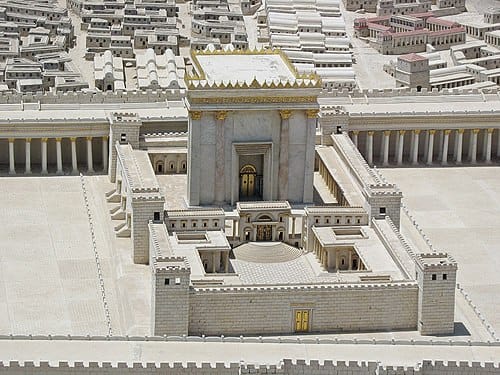
The Temple functions as the economic engine of Jerusalem — the half-shekel tax, the sacrificial animal trade, the money-changing monopoly. And the entire operation takes place in the Court of the Gentiles — the one area where the nations are supposed to have access to worship. Jesus overturns the tables and quotes Isaiah 56:7: "My house will be called a house of prayer for all nations." The money changers are the physical obstruction between the nations and the intersection. The carrier's institutional apparatus blocking the signal's delivery. The tables are the barrier. Jesus removes them.
Above all five factions sits the Sanhedrin — the supreme council of seventy-one elders, combining judicial, legislative, and religious authority, meeting in the Hall of Hewn Stone within the Temple complex. Its composition reflects the factional tension: Sadducean priestly aristocracy controls the high priesthood and the majority of seats, but Pharisaic scholars hold significant influence through their popular legitimacy and legal expertise. The Sanhedrin retains jurisdiction over religious law under Rome but has lost the right of capital punishment — the ius gladii reserved to the Roman prefect. This jurisdictional structure is why Jesus must be handed to Pilate: the Sanhedrin condemns him for blasphemy (a religious charge), then reframes the accusation as sedition ("He claims to be king" — a political charge) to secure Roman execution. The cross is a Roman instrument. The condemnation is a Jewish-Roman co-production — both systems participating in the death the covenant required.
Among the Pharisaic members of the Sanhedrin, one figure illuminates the intellectual calibre of the institution: Gamaliel the Elder — grandson of Hillel, president (Nasi) of the Sanhedrin, holder of the honorific "Rabban" ("our master," a rank above "Rabbi"). When the apostles are arrested in Acts 5, it is Gamaliel who intervenes: "If this plan or this undertaking is of man, it will fail; but if it is of God, you will not be able to overthrow them" (Acts 5:38-39). The council listens — because Gamaliel's authority is unquestioned. He is the most distinguished legal scholar of his generation.
And Gamaliel's most brilliant student is Saul of Tarsus — the man who will become Paul. "I am a Jew, born in Tarsus in Cilicia, but brought up in this city, educated at the feet of Gamaliel according to the strict manner of the law of our fathers" (Acts 22:3). Paul is not a marginal convert. He is the intellectual elite of first-century Judaism — trained by the greatest Pharisaic scholar alive, authorised by the high priest to persecute the Church (Acts 9:1-2), a Hebrew of Hebrews, of the tribe of Benjamin, a Pharisee of Pharisees (Philippians 3:5). His conversion is not the conversion of an ignorant person overwhelmed by emotion. It is the conversion of someone who understood the Hebrew scriptures at the highest possible level of training and concluded — against every institutional incentive, at catastrophic personal cost — that Jesus of Nazareth is the Messiah the scriptures describe. The game-theoretic weight of Paul's conversion is not merely that he switched sides. It is that the most qualified reader of the deposit in the first century read it and concluded it pointed to Jesus — and then spent thirty years and his life defending that conclusion.
Josephus records the apocalyptic pressure: "What more than all else incited them to the war was an ambiguous oracle found in their sacred scriptures, to the effect that at that time one from their country would become ruler of the world" (Jewish War 6.312-313). The Daniel computation driving the Zealot conviction. They were right about the timing. Wrong about the mechanism.
The principalities operate at maximum intensity. The imperial cult installs Caesar's titles — Lord, Saviour, Son of the Divine — on every coin. The New Testament's titles for Jesus are direct counter-claims to Caesar's. The demonic activity is disproportionate: "Have you come to destroy us before the appointed time?" (Matthew 8:29). They know who he is. They know there is an appointed time.
Into this convergence — Daniel's fourth beast occupying the land, the sceptre departed, the computation expiring, five strategies failing, the Temple corrupted, the nations blocked, the principalities at maximum alert — Isaiah 40:3 is fulfilled: "A voice cries in the wilderness: Prepare the way of YHWH; make straight in the desert a highway for our God."
This is literal. If Jesus IS the Davar YHWH who walked in Eden, the Malak YHWH who led Israel through the wilderness as cloud and fire, the Memra who walked in the garden — then "prepare the way of YHWH" means: YHWH is coming to walk on physical roads. Make them straight. The same feet that walked in Eden will walk the roads of Galilee. The same Person who led through the desert will walk through the desert to the Jordan. "Make straight the way of the Lord" is not metaphor. It is logistics. The Owner is arriving in person. Prepare the route.
The voice preparing that route is John. The empty chair fills. Elijah has come.
VIII. The Person
Jesus of Nazareth rides into Jerusalem on Nisan 10, 33 CE — the exact day Daniel's 69 weeks compute, the day Zechariah 9:9 specifies, the day the Passover lamb is selected per Exodus 12:3. He performs the 4Q521 checklist and cites it as his credential. He claims the divine Name: "Before Abraham was, ego eimi" (John 8:58). He forgives sins, accepts worship, and says "I and the Father are one."
The theophanic identity connects him to every appearance of the Logos throughout the canon. The feature-by-feature consistency is precise: compare Daniel 10:5-6 — "a man clothed in linen, belt of fine gold, body like beryl, face like lightning, eyes like flaming torches, arms and legs like burnished bronze, voice like the sound of a multitude" — with Revelation 1:13-16 — "one like a son of man, clothed in a long robe, golden sash, eyes like a flame of fire, feet like burnished bronze, voice like many waters." The same Person. Seven centuries apart. The appearance is consistent because the Person does not change. Daniel saw the pre-incarnate Logos in the same form John saw the resurrected Logos.
This is the Person who walked between the pieces in Genesis 15, who appeared to Hagar as the Angel of YHWH (Genesis 16), who dined with Abraham at Mamre flanked by two angels (Genesis 18), who wrestled Jacob at the Jabbok, who spoke the Name from the burning bush, who descended on Sinai as fire, who spoke to Moses face to face, who filled the Tabernacle and Temple with glory. Isaiah saw him enthroned (Isaiah 6:1), and John confirmed: "Isaiah said these things because he saw his glory and spoke of him" (John 12:41). The Archetype has entered the domain of the ectype. The Original has stepped into the copy's frame.
Three linguistic traditions name this Person. The Hebrew calls Him the Davar YHWH — the Word of the LORD. "By the word of the LORD the heavens were made" (Psalm 33:6). The Davar "came to" the prophets — and when it came to Jeremiah, it had a hand: "The LORD put out His hand and touched my mouth" (Jeremiah 1:9). Not an impersonal force. A Person who speaks, acts, touches, and is sent. The Aramaic calls Him the Memra — the Word. The Targums systematically insert Memra where the Hebrew text describes God acting in the world: "They heard the voice of the Memra of the LORD God walking in the garden" (Targum Neofiti, Genesis 3:8). The Memra creates, reveals, saves, judges — every function the New Testament attributes to the Logos. The theophanic tradition calls Him the Malak YHWH — the Angel of the LORD, the Messenger who IS YHWH yet is sent by YHWH. He appears to Hagar and she calls Him God (Genesis 16:13). He speaks from the bush and identifies Himself as "I AM" (Exodus 3:14). YHWH says of Him: "My Name is in him" (Exodus 23:21) — not "I have given him authority" but "My Name IS in him," a statement of identity so complete that disobedience to the Angel is disobedience to God.
Three names. One Person. Davar = Memra = Malak YHWH = the Logos of John 1 = the Lamb of Revelation 5. And He IS Ehyeh — He IS YHWH. "Before Abraham was, ego eimi — I AM" (John 8:58). He claimed the Name in its fullness, not merely a derivative of it. "My Name is in Him" (Exodus 23:21) is not delegated authority — it is identity. The Father is Ehyeh. The Son is Ehyeh. They are one — and the Spirit is the Asher, the WHO, the relational bond between them. The Spirit of the Father IS the Spirit of the Son (Galatians 4:6, Romans 8:9). The Spirit is the mutual indwelling, the perichoresis itself — the WHO that connects the two I AMs, that searches all things, even the deep things of God (1 Corinthians 2:10), and makes each known through the other. The Name has three words because the Person has three operations: the Father conceives (Ehyeh), the Spirit connects and actualises (Asher), the Son specifies (Ehyeh). One ousia, three hypostaseis. Each fully YHWH. John's prologue did not introduce a new concept. It translated into Greek what the Hebrew deposit called Davar, the Aramaic called Memra, and the theophanic tradition called the Angel of YHWH — the one through whom the Father creates, reveals, and saves, who is distinct from the Father yet carries the Father's Name in its fullness, who IS God yet is sent by God. "In the beginning was the Word, and the Word was with God, and the Word was God" (John 1:1). With God — distinct. Was God — identical. The two powers. The Name. And "the Word became flesh and tabernacled among us" (John 1:14) — the Davar/Memra/Malak who walked in Eden, who appeared at the bush, who filled the Temple, now permanently embodied. The theophanic thread's terminus. The Person behind every appearance, now standing in Galilee with dust on His feet.
Trace it. He IS the one who formed Adam from the dust and breathed into his nostrils the breath of life (Genesis 2:7) — the Davar whose speech is the boundary encoding, whose breath is the Spirit's actualisation. He IS the one who walked in the garden in the cool of the day (Genesis 3:8) — the Memra of the LORD God, whose footsteps Adam heard before the fall ruptured the intersection. He IS the one who called Abraham from Ur, who covenanted with him between the pieces, who dined with him at Mamre, who announced Isaac's birth while the two angels went ahead to Sodom. He IS the one who wrestled Jacob at the Jabbok until daybreak — and Jacob said, "I have seen God face to face, and yet my life has been delivered" (Genesis 32:30). He IS the one who spoke the Name from the burning bush — "I AM WHO I AM" — to the man He was commissioning to deliver the carrier from Egypt. He IS the pillar of cloud by day and fire by night — the Malak YHWH going before Israel (Exodus 14:19), of whom YHWH said "My Name is in Him." He IS the one who descended on Sinai as fire, who spoke the Torah from the mountain, who fed Israel manna in the wilderness. He IS the one who appeared to Gideon, to Manoah, to the prophets — Isaiah seeing Him enthroned, Ezekiel seeing the glory, Daniel seeing the Palmoni between the rivers.
And then He incarnates. The same Person who made Adam now becomes a son of Adam. The same Person who breathed life into the first man now takes His first breath as an infant in Bethlehem. The same Person who walked in Eden now walks the roads of Galilee. The same Person who filled the Temple with glory now enters the Temple as a man — and the glory of the latter house exceeds the former (Haggai 2:9) because the glory is no longer cloud and fire. The glory is the Person Himself.
This is why, when Jesus weeps over Jerusalem on the day of the Triumphal Entry — Nisan 10, 33 CE, the exact day Daniel's 69 weeks compute — His words carry the weight of the entire theophanic history: "If you had known, even you, the things that make for your peace! But now they are hidden from your eyes... because you did not know the time of your visitation" (Luke 19:41-44). The word visitation — episkopē — means an official inspection, a lord visiting his estate, a king entering his territory. Jesus is not saying "you didn't recognise the Messiah." He is saying: the Person who made you, who walked with your father Abraham, who wrestled your father Jacob, who spoke to Moses, who led you through the wilderness, who filled your Temple — that Person is HERE, in THIS body, on THIS day, at THIS coordinate, and you do not recognise Me. The visitation is not the arrival of a stranger. It is the return of the Owner. And the Owner is weeping — because the city that bears His Name does not know His face.
The cross is the oath-keeper paying the oath's cost. The Logos walked between the pieces. The oath was His. The Name was His. When the Son bears the curse (Galatians 3:13), the Father bears it too — experienced from the Son's position within the single divine life. The Trinity does not outsource the cost. It absorbs it. "He who did not spare his own Son but gave him up for us all, how will he not also, along with him, graciously give us all things?" (Romans 8:32). If the oath-keeper paid the maximum cost, every lesser fulfilment is guaranteed.
He is crucified on Nisan 14 — the day the Passover lamb is slain. The veil tears from top to bottom (Matthew 27:51). And the Temple system's own testimony begins. Yoma 39b records that for forty years before the destruction — that is, from approximately 30 CE — the scarlet thread tied to the scapegoat on Yom Kippur ceased turning white. The thread's whitening had been the visible sign that the Day of Atonement sacrifice was accepted (based on Isaiah 1:18: "though your sins be as scarlet, they shall be white as snow"). When it stopped turning white, the sacrificial system was testifying against itself — atonement was no longer being accomplished there because it had been accomplished elsewhere. The lot for the LORD's goat ceased falling on the right hand — the Yom Kippur mechanism no longer functioned as designed. The western lamp went out. The Temple doors opened by themselves — as if the House were saying: enter, for the veil is torn; or leave, for the glory has departed. The Second Temple had no Ark, no mercy seat. The blood of atonement had no place to be applied. The atonement mechanism was already structurally broken — and now the Temple signs confirmed that even the vestigial system had ceased to function. Something had changed. The rabbis recorded it without understanding what they recorded: the real atonement had been made on a cross outside the city walls, and the Temple's own signs were the receipt.
The historical reality of Jesus' execution is confirmed by multiple independent, non-Christian sources. Tacitus (Annals 15.44, c. 116 CE) — a Roman senator hostile to Christianity — records that "Christus" was executed under Pontius Pilate during the reign of Tiberius, and that the "pernicious superstition" broke out again after his death. Josephus (Antiquities 18.3.3 and 20.9.1) — a Jewish historian writing for Roman patrons — references Jesus twice: the contested Testimonium Flavianum (even in its stripped-down scholarly reconstruction, it confirms Jesus as a teacher who was crucified under Pilate and whose followers persisted), and the uncontested reference to "James, the brother of Jesus who was called Christ." The Pilate Stone — discovered at Caesarea Maritima in 1961 — confirms Pontius Pilate as prefect of Judaea, the exact title Luke uses. The Talmud (Sanhedrin 43a) provides adversarial testimony: "On the eve of Passover, Yeshu was hanged... because he practised sorcery and led Israel astray." The rabbis did not deny the execution. They did not deny the miracles — they attributed them to sorcery. And the Quran (4:171) — a text written six centuries later with the explicit intent of denying Jesus' divinity — cannot discuss him without calling him "His Word" (kalimatuhu) and "a spirit from Him" (ruhun minhu), two of the three Trinitarian terms, applied exclusively to Jesus with the Arabic preposition of origin. The grammar says what the theology denies.
Hostile witnesses confirm the Person. Adversarial sources confirm the events. A text designed to refute his identity preserves his titles. The testimony against him is testimony for him.
Three days later, the tomb is empty. The witness pair — one at the head and one at the feet (John 20:11-12) — sit in the same configuration as the cherubim on the mercy seat. The glory has exited the tomb. The Encoder has exited the encoding — with the scars still on his hands.
And then the apostles act. Consider who they are. Galilean fishermen — Peter, Andrew, James, John — working-class Jews from an occupied province, not the intellectual elite. A tax collector (Matthew) — collaborating with Rome, despised by his own people. A zealot (Simon) — the opposite extreme, a nationalist militant. These men had watched their leader arrested, tried, tortured, and executed by the method reserved for slaves and the lowest criminals. Every rational incentive pointed toward defection. The leader was dead. The movement was discredited. The authorities were hostile. Continuing meant social ostracism, loss of livelihood, separation from family, imprisonment, and eventual execution. Defecting meant return to normal life — the boats, the nets, the tax booth, the community that would take them back if they recanted.
Not one defected. All eleven remaining apostles chose costly persistence unto death. Peter — crucified upside down in Rome. James son of Zebedee — beheaded by Herod Agrippa (Acts 12:2), the first apostolic martyr. James the brother of Jesus — thrown from the Temple pinnacle, then clubbed (Josephus, Antiquities 20.9.1). Andrew — crucified in Patras. Thomas — speared in India. The pattern holds across the group. Under any rational model — fabricators defect under pressure. Cult followers sometimes die for leaders, but cults collapse when the leader dies and cannot deliver promises. The apostles died for a claim that was already falsifiable: either Jesus rose or he did not. They were in a position to know which.
They continued as observant Jews. After the resurrection and Pentecost, they went to the Temple daily (Acts 2:46). Peter and John went up to the Temple at the hour of prayer (Acts 3:1). They kept Torah. They observed the feasts. They circumcised their children. James, the Lord's brother, was known as "James the Just" — so scrupulous in Torah observance that even the Pharisees respected him. The Jerusalem church was thoroughly Jewish. They did not understand themselves as founding a new religion. They were Jews who had recognised the Messiah their scriptures described — and the recognition had cost them everything.
The cross offended every culture they evangelised. For Jews: "Cursed is everyone who hangs on a tree" (Deuteronomy 21:23, cited by Paul in Galatians 3:13). A crucified Messiah was a contradiction in terms. The Messiah was supposed to conquer, not die in shame. The cross was the ultimate disqualification. For Greeks: a crucified God was absurd. Greek culture valued wisdom, beauty, power, philosophical transcendence. A deity who dies on a Roman torture device — the punishment for slaves — was intellectually contemptible. Cicero said crucifixion should not be mentioned in polite Roman company. The Alexamenos graffito — scratched into a wall in Rome around 200 CE, the earliest known depiction of the crucifixion — shows a man worshipping a figure on a cross with a donkey's head. The inscription: "Alexamenos worships his god." The cross was so offensive that the earliest visual representation of it is mockery.
Paul acknowledges the double offense: "We preach Christ crucified: a stumbling block to Jews and foolishness to Gentiles" (1 Corinthians 1:23). A stumbling block (skandalon) to Jews — the Torah itself seems to condemn the crucified one. Foolishness (mōria) to Greeks — the claim is intellectually beneath contempt. Nobody invents a crucified Messiah. If you are fabricating a religion, you do not choose the most offensive possible central claim — one that repels your Jewish audience and disgusts your Greek audience simultaneously. The cross's offensiveness is evidence of its historicity. You only proclaim something this culturally toxic if it actually happened and you actually saw the aftermath.
And Paul — whose pedigree the Sanhedrin section has established: Gamaliel's finest student, the most qualified reader of the deposit alive. He lists the cost of his conviction: "Five times I received forty lashes minus one. Three times I was beaten with rods. Once I was pelted with stones. Three times I was shipwrecked. I spent a night and a day in the open sea" (2 Corinthians 11:24-25). No material gain. No political power. No comfort. Thirty years of suffering for a claim he was positioned to evaluate better than any human alive — that the cursed one on the cross is the Lord of glory — and then executed in Rome under Nero.
The mass witness claim seals the game theory. 1 Corinthians 15:6 — written around 55 CE, within twenty-five years of the events — states that the risen Jesus appeared to more than five hundred people simultaneously, "most of whom are still alive." This is a falsifiable claim made while falsification was possible. Paul is saying: go ask them. They are still alive. Check. The claim is not "a vision to one person in a cave." It is a public appearance to five hundred, written up while the witnesses are still available for cross-examination.
The probability that this behavioural pattern — eleven apostles choosing death, the chief persecutor switching sides at catastrophic cost, the mass witness claim made while falsifiable — emerges from fabrication is approximately 10^-5.
Three independent proofs now converge on the resurrection as a single event.
The first is physical. The Shroud of Turin — whatever one's position on its authenticity — presents anomalous properties that no known process can replicate: a photographic negative (discovered only when Secondo Pia photographed it in 1898), three-dimensional spatial information encoded in a two-dimensional surface (confirmed by VP-8 Image Analyzer, the same technology used for NASA terrain mapping), an image affecting only the topmost fibrils of the linen with no paint, dye, pigment, or scorching mechanism identified after decades of investigation. The blood is real (type AB, containing bilirubin consistent with severe trauma), applied before the image formed — meaning the body bled onto the cloth and then the image formed through a process that left the bloodstains undisturbed. The wound pattern matches the Gospel accounts with forensic precision: scourging across the back, crown of thorns producing scalp wounds, nail wounds in the wrists (not the palms — anatomically correct for crucifixion, contrary to medieval artistic convention), lance wound in the side. The image is consistent with a burst of vacuum ultraviolet radiation from within the cloth — the Encoder exiting the encoding by a mechanism that photographs the body's surface information onto the burial linen. Physics cannot explain how the image formed. Physics CAN describe what the image's properties require: a body-shaped radiation source of extremely short duration. The Shroud is the physical receipt.
The second is behavioural. The apostolic game theory — 10^-5 probability under fabrication. They saw something that transformed their behaviour from hiding behind locked doors (John 20:19) to public proclamation at the cost of their lives. Their testimony is consistent only with truth-witnesses who encountered the risen Person.
The third is mathematical. The 69-week day count — 173,880 days from Artaxerxes' decree to the Triumphal Entry, verified by Anderson in 1894, confirmed computationally. The Person arrived at the exact coordinate Daniel predicted five centuries earlier. The chronological framework is real. Its precision is demonstrated. The 70th week inherits that precision.
Physics, behaviour, and mathematics. Three independent methods. Three different evidence types. One convergence: the Person who was crucified on Nisan 14 exited the tomb on the third day by a mechanism that left physical evidence on linen, behavioural evidence in the apostles, and chronological evidence in the calendar.
I want to be direct about what I think this means. This is not "interesting." This is not "suggestive." Three independent verification systems — each alone sufficient to warrant serious investigation — converge on the same event. The probability of this convergence under fabrication is vanishingly small. The apostolic foundation validates the Person. The Person validates the scriptures. The scriptures provide the architecture. The architecture computes the coordinates. And the coordinates are five months away.
The trigger is compounding: decades of Roman provocations, Zealot agitation, and the Daniel computation convincing a critical mass that the time for deliverance has arrived. The procurator Gessius Florus (64-66 CE) pushes the province past the breaking point — seizing seventeen talents from the Temple treasury, then massacring protesters. In 66 CE, the priestly establishment takes the decisive step: they cease the daily sacrifice offered on behalf of the Roman emperor. This is the formal act of rebellion — the Temple declaring independence from Rome's sovereignty. The Zealots seize Jerusalem. A Roman relief force under Cestius Gallus — the XII Legion — is defeated at Beth Horon. The impossible has happened: Judea has beaten Rome in open battle. The Maccabean template seems to be working. The belief is God is fighting with the faithful.
Rome's response is systematic. Vespasian campaigns through Galilee in 67 CE, then Judea in 68 CE, reducing the province fortress by fortress. The civil war in Rome (the Year of the Four Emperors, 69 CE) pauses the campaign. Vespasian becomes emperor. His son Titus completes the siege of Jerusalem in 70 CE. The Temple is burned on the 9th of Av — the same Hebrew date as the destruction of Solomon's Temple by Nebuchadnezzar in 586 BCE. The same date. Five centuries apart. The carrier's two Temples destroyed on the same day of the Jewish calendar. Josephus records over a million dead in Jerusalem, ninety-seven thousand enslaved. Masada falls in 73 CE. The war Jesus predicted — "not one stone will be left upon another" (Matthew 24:2), "your enemies will build an embankment against you and encircle you and hem you in on every side" (Luke 19:43) — is fulfilled with the specificity the 69-week calculation established as baseline.
Daniel 9:26 had prophesied this in the same passage that computed the Messiah's arrival: "After the sixty-two weeks, an anointed one shall be cut off and shall have nothing. And the people of the prince who is to come shall destroy the city and the sanctuary." The Messiah cut off. Then the city and sanctuary destroyed. The sequence is specified. The order is exact.
The destruction's severity is disproportionate — and the comparison with neighbouring provinces reveals why. Syria became a Roman province peacefully in 64 BCE under Pompey. Egypt was absorbed after Actium in 30 BCE under Augustus. Both were integrated into the empire without the annihilation of their capitals or the razing of their central sanctuaries. Rome suppressed rebellions elsewhere — Gaul, Britain, Germania — but did not systematically dismantle the conquered civilisation's religious infrastructure. Jerusalem is unique. The Temple is not merely damaged but obliterated. The population is not merely punished but decimated and dispersed. The province is not merely pacified but renamed — Hadrian, after the Bar Kokhba revolt of 135 CE, renames Judea "Syria Palaestina" and Jerusalem "Aelia Capitolina," attempting to erase the connection between the people and the land. No other Roman province receives this treatment. The disproportionate response is explicable only if the covenant enforcement mechanism — Deuteronomy 28-30 — is operative. Rome is the instrument. The covenant is the cause. "I will scatter you among the nations" (Leviticus 26:33) is not a metaphor. It is a contract term, executed by the fourth beast of Daniel's vision.
The destruction is not random. It is the covenant's enforcement mechanism operating as Deuteronomy 28-30 specifies. The basis for judgment is dual: Israel did not acknowledge the prophet like Moses (Deuteronomy 18:15 — Jesus), and the atonement the Temple was supposed to provide had not been accomplished there for forty years. The scarlet thread had stopped turning white in ~30 CE. The real atonement was made at Calvary. Israel rejected both the atonement and the Person who made it. The result is exile — not the seventy-year exile of Babylon but an almost two-thousand-year exile, the longest in the carrier's history.
The genealogical records are burned. After 70 CE, no messianic claimant can verify Davidic lineage. The window for a genealogically verifiable Messiah closes permanently. Matthew and Luke recorded Jesus' genealogies before the destruction — Matthew tracing the legal line through Joseph to David via Solomon, Luke tracing the biological line through Mary to David via Nathan. These are the last Davidic genealogies in existence. Every subsequent claimant — Bar Kokhba (132 CE), Sabbatai Zevi (1666), or any future figure — cannot produce what the covenant requires: verified descent from David. The Messiah had to come before 70 CE, or the qualification could never be met. The 69-week computation expired in 33 CE. The genealogies were destroyed in 70 CE. Jesus is the last Person in history whose Davidic credentials are on record.
The destruction reshapes Judaism itself. Of the five factions, four are destroyed by the war. The Sadducees — whose entire function depended on the Temple — cease to exist when the Temple ceases to exist. The Essenes are overrun at Qumran (their scrolls hidden in caves, not recovered for nineteen centuries; the Dead Sea Scrolls). The Zealots are killed at Masada or scattered. The common people are decimated — Josephus records over a million dead in Jerusalem alone. Only the Pharisees survive — because their infrastructure (the synagogue) and their method (Torah study independent of the Temple) are portable. Rabbi Yohanan ben Zakkai escapes besieged Jerusalem (smuggled out in a coffin, according to tradition), obtains Roman permission to establish an academy at Yavneh (Jamnia), and reconstitutes Jewish religious life around the synagogue, the oral Torah, and rabbinic authority. The Pharisees become the rabbis. Rabbinic Judaism — the Judaism that exists today — is Pharisaic in structure. The oral Torah becomes the Mishnah (codified c. 200 CE), then the Talmud (completed c. 500 CE). The system Jesus contested — not Torah itself but the fence that replaced Torah's heart — becomes the carrier's operating system for the next two millennia. The irony is architectural: the faction that most resisted the Messiah is the faction that survived to carry the deposit that testifies to the Messiah. The signal preserved by the operators who cannot hear it.
The Jewish Christians' attitude toward the Roman invasion was shaped entirely by Jesus' own words — and it made reconciliation with the broader Jewish community impossible. Jesus had not merely predicted the destruction; He had wept over it (Luke 19:41-44), framed it as the consequence of rejecting the visitation ("because you did not know the time of your visitation"), and given specific operational instructions to flee when the armies appeared (Luke 21:20-21, Matthew 24:15-16). The Christians therefore understood the war not as a national liberation struggle to be supported but as a prophesied judgment to be escaped. When Cestius Gallus's legions briefly withdrew in 66 CE — the moment Eusebius (Historia Ecclesiastica 3.5.3) identifies as the Christians' window to flee to Pella — the Jewish Christians read the withdrawal as the providential opening Jesus had promised. They left. From their perspective, they were obeying the prophet like Moses. From the perspective of every other Jew in Jerusalem — Zealot, Pharisee, Sadducee, common citizen — the Christians were deserting the holy city during its darkest hour, effectively siding with God's judgment against their own people. The theological offense compounded the social betrayal: after the destruction, Christian writers (the Epistle of Barnabas 16.1-5; Justin Martyr, Dialogue with Trypho 16; later Origen, Contra Celsum 1.47, 4.22) interpreted the Temple's fall as divine confirmation that the old covenant had been superseded — that God had judged Jerusalem for crucifying His Son. Whether or not this framing was theologically accurate in its sharpest forms, it was experienced by the surviving Jewish community as triumphalism over their catastrophe. The Christians had fled the war, survived, and then theologised the destruction as proof they were right. The wound never healed.
The institutional rupture formalised what the war had fractured. The Birkat HaMinim — the twelfth benediction of the Amidah, reformulated at Yavneh under Rabban Gamaliel II around 90 CE (Talmud Berachot 28b-29a; corroborated by Justin Martyr, Dialogue with Trypho 16, 47, 96, who reports that Jews "curse in your synagogues all those who believe in Christ") — targeted the Notzrim and minim, functioning as a liturgical loyalty test embedded in the prayer every Jew recited three times daily. If you were a Jewish follower of Jesus, you would be required to pronounce a curse upon yourself to remain in the synagogue. The mechanism was elegant and devastating — not a formal excommunication decree but a prayer that made participation impossible for anyone in the targeted category. The Bar Kokhba revolt (132-135 CE) completed the separation. Rabbi Akiva — the greatest Talmudic scholar of his generation — declared Simon bar Kokhba to be the Messiah (Jerusalem Talmud, Ta'anit 4:8). Jewish Christians could not endorse a second messianic claimant. They refused to join the revolt. Justin Martyr records that Bar Kokhba "ordered Christians alone to be led to cruel punishments, unless they would deny Jesus the Christ and blaspheme" (First Apology 31.6). After Hadrian crushed the revolt, renamed Judea "Syria Palaestina," and barred Jews from Jerusalem, the parting of the ways was institutionally complete. James D.G. Dunn's The Parting of the Ways (1991; 2nd ed. 2006) and Daniel Boyarin's Border Lines: The Partition of Judaeo-Christianity (2004) both demonstrate that the boundary was not always there — it was actively constructed by both communities to exclude precisely the middle ground the Jewish Christians occupied.
The Nazarenes — described by Epiphanius (Panarion 29) and Jerome (Commentary on Isaiah 8:14; Letter 112 to Augustine) — were the direct heirs of the Jerusalem church. They maintained Torah observance, used a Hebrew Gospel, affirmed the virgin birth and divinity of Christ, and were orthodox in every respect except their continued Jewish practice. Jerome noted they were "cursed by the Pharisees in their synagogues" yet simultaneously regarded with suspicion by Gentile Christians who could not understand why believers in Jesus would still circumcise their children and keep the dietary laws. The Ebionites (Epiphanius, Panarion 30; Irenaeus, Against Heresies 1.26.2) held a lower Christology — denying the virgin birth, regarding Jesus as a prophet adopted at baptism — and were rejected as heretical by the mainstream Church. Ray Pritz's Nazarene Jewish Christianity (1988) and Oskar Skarsaune's In the Shadow of the Temple (2002) trace how both communities persisted into the fourth and fifth centuries but progressively disappeared — absorbed into Gentile Christianity, absorbed into rabbinic Judaism, or simply fading as institutional pressure from both sides eliminated the space they occupied. The irony is architectural: the one community that had both the deposit AND the key — Jews who kept Torah, observed the feasts, recognised the Messiah, and had obeyed His instruction to flee — became the casualty of the very separation they could have bridged. The bridge was destroyed by the two banks it connected.
And the basis for the exile — the dual rejection of the atonement and the prophet — remains unresolved. The return to the land in 1948 ended the exile geographically but not covenantally. Israel is back in the land without Temple, without functioning atonement, without Torah as constitutional order, and without acknowledgment of the prophet like Moses. The conditions that triggered the exile persist. This is not a historical curiosity. It is the setup for the chiasm — the Song of Moses in action. The carrier is in the state Deuteronomy 32 describes: regathered but not redeemed, preserved by the covenant's irrevocability but not yet restored to the covenant's fulness. The vindication comes "when their power is gone" — at Yom Kippur 2033, when the real High Priest applies the real atonement to the nation that rejected it, and the scarlet thread turns white at last.
IX. The Gap
He ascends. A cloud takes him. The two angels promise: "This Jesus will come in the same way" (Acts 1:11). The concealment resumes. The pattern 1 Enoch described — concealment, revelation, concealment, final revelation — continues.
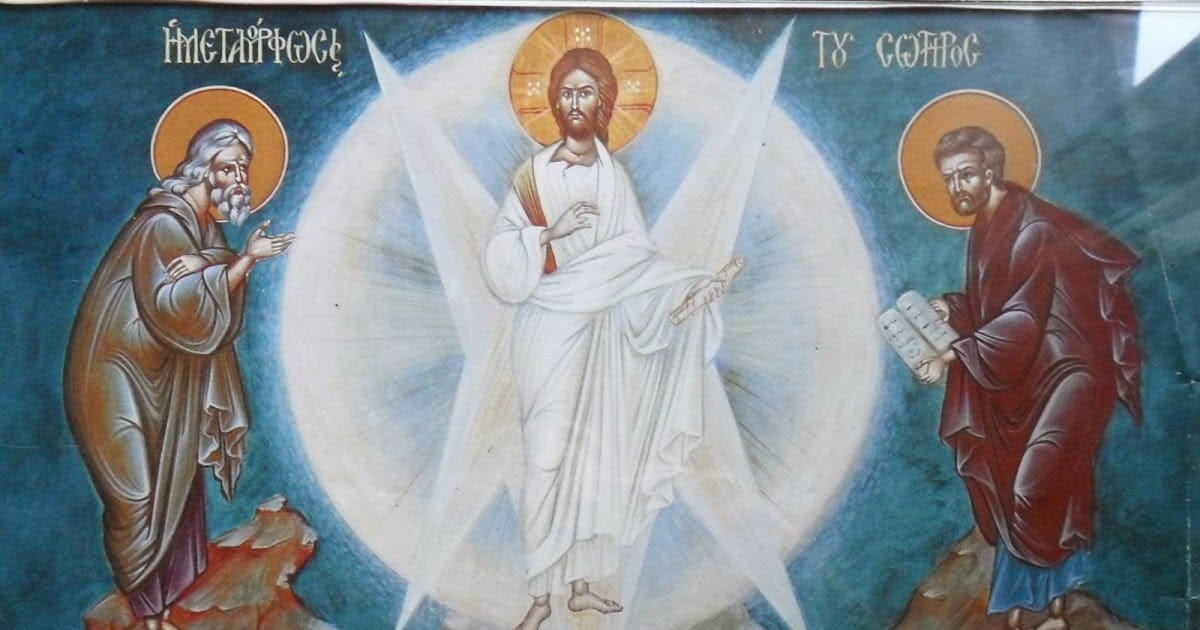
Pentecost. The theophanic fire distributes. Tongues of flame on each one. The glory localised on the mercy seat, in the Temple, in the incarnate body, now fills every believer. "Do you not know that you are God's temple and that God's Spirit dwells in you?" (1 Corinthians 3:16). The progressive reopening advances: Pentecost distributes what the cross opened.
Israel's rejection is the architecture operating as designed. "Through their trespass, salvation has come to the Gentiles" (Romans 11:11). The rejection creates the gap — the Church age — during which the signal reaches every nation on the roster. The Song of Moses predicted it before Israel crossed the Jordan: "I will make them jealous with those who are no people" (Deuteronomy 32:21). Paul cites it (Romans 10:19). The carrier's temporary deafness is the mechanism of universal inclusion.
This is Phase 1 of the "light to the nations." Isaiah 49:6 specified the scope: "It is too small a thing for you to be my servant to restore the tribes of Jacob; I will also make you a light for the nations, so that my salvation may reach to the ends of the earth." The Servant's mission exceeds Israel. The signal is for every family on the Deuteronomy 32 roster — every people currently administered by a corrupted overseer. The Great Commission (Matthew 28:19-20) is the operational expression: "Go and make disciples of all nations." Acts traces the trajectory: Jerusalem → Judea → Samaria → the ends of the earth (Acts 1:8). The pattern is centrifugal — the signal radiates outward from the carrier to the nations the carrier was always meant to reach.
Each conversion during the gap is a citizen of a principality-administered territory being transferred to the kingdom of the Son. Colossians 1:13: "He has rescued us from the domain of darkness and transferred us into the kingdom of the Son he loves." The gospel is a repatriation programme — taking persons held under the corrupted Deuteronomy 32 overseers and relocating them under the direct sovereignty of the Logos. Revelation 5:9: "You purchased for God persons from every tribe and language and people and nation." The Lamb's death is the purchase price. The gap is the delivery period. The "fullness of the Gentiles" (Romans 11:25) is the completion of the delivery list — when the last person on the roster has been reached, the gap closes and the Deliverer comes from Zion.
But the gap has a terminus. "A hardening in part has happened to Israel until the fullness of the Gentiles has come in" (Romans 11:25). Until. Then: "The Deliverer will come from Zion." At coordinates the architecture computes.
The principalities' infrastructure is commandeered. Greek language, Roman roads, Pax Romana — built for conquest, repurposed for the gospel. The carrier is scattered, and the scattering ensures the deposit's survival. The Dead Sea Scrolls verify 95% agreement across a millennium of independent transmission. The carrier preserves the deposit — including the deposit's prediction that the carrier would reject the one the deposit describes.
During the gap, two communities evolve in parallel — each carrying part of the truth, each losing what the other preserves. I've come to see this as one of the most important dynamics in the entire arc, and it's one that most Christians and most Jews miss because each community only sees its own half.
Judaism transforms. With the Temple destroyed and the sacrificial system ended, the rabbis at Yavneh reconstitute Jewish life around what survives: Torah study, synagogue worship, prayer replacing sacrifice, and the oral tradition codified into written form. The Tannaim (70-200 CE) produce the Mishnah — six orders of law covering every dimension of Jewish life. The Amoraim (200-500 CE) produce the Talmud — the Babylonian and Jerusalem compilations of commentary, debate, and case law that become the operational constitution of Jewish existence in exile. The system is brilliant — portable, resilient, communal, intellectually demanding. It preserves the deposit with extraordinary fidelity. The Hebrew text, the feast calendar, the sabbatical cycles, the covenant structure — all transmitted intact across two millennia of dispersion, pogrom, and Holocaust. But the system also develops defensive readings of the texts the deposit contains. Isaiah 53 — which the Targums, the Talmud, and earlier sources had read as referring to an individual Messiah — is reinterpreted by Rashi (1040-1105) as referring to collective Israel. The "two powers in heaven" tradition — which had been a live option in Second Temple theology — is declared heretical precisely because Christians use it. The Birkat HaMinim — a liturgical "blessing" against heretics, including Jewish Christians — formalises the separation. Judaism preserves the architecture but develops antibodies against the Person the architecture describes.
Christianity transforms in the opposite direction. The movement begins as a Jewish sect — the Jerusalem church under James, the apostles in the synagogues, Paul visiting the synagogue first in every city. The Jerusalem Council (Acts 15) establishes that Gentiles need not become Jews to follow the Jewish Messiah — the correct decision, rooted in Isaiah 49:6 and the Abrahamic covenant's universal scope. But as the Gentile majority grows and the Jewish minority shrinks — accelerated by the destruction of 70 CE, the Bar Kokhba revolt of 135 CE, and the progressive expulsion of Jewish Christians from the synagogue — the movement loses its Hebrew vocabulary. The theology is translated into Greek philosophical categories: logos for davar, ousia for the divine nature, hypostasis for the Persons. The councils (Nicaea 325, Constantinople 381, Chalcedon 451) formalise in Greek what was originally articulated in Hebrew categories — and the formulations are precise, but the Hebrew soil from which they grew is increasingly forgotten. The feasts are delinked from their prophetic architecture — Passover becomes Easter, the sabbath shifts to Sunday, the fall feasts lose their eschatological function. And most damagingly, replacement theology (supersessionism) develops — the claim that the Church has replaced Israel, that the covenant with the Jewish people is revoked, that the promises to Israel now apply exclusively to the Church. This directly contradicts Romans 11:1 ("Has God rejected his people? By no means!"), Romans 11:29 ("the gifts and calling of God are irrevocable"), and the entire olive tree argument. Supersessionism is the Gentile Church's mirror error of Jewish rejection: Judaism denies the Person the deposit describes; supersessionist Christianity denies the carrier the Person chose.
The two errors are architecturally complementary. Judaism carries the deposit but not the key. Christianity carries the key but forgets the lock. Judaism preserves the feast calendar, the Hebrew text, the covenant structure, the land theology — but cannot read what they point to. Christianity preserves the Person, the resurrection, the atonement, the Great Commission — but progressively disconnects from the Hebrew architecture that gives those realities their prophetic precision. Each community has what the other needs. Neither can be complete without the other.
This is why the New Jerusalem has twelve gates AND twelve foundations. The architecture requires both. And it is why the present moment — when the Hebrew calendar is being reconnected to the prophetic integers, when Jewish believers in Jesus are recovering the feast architecture, when the Diamond Chiasm demonstrates that the Hebrew deposit and the Christian proclamation converge on the same coordinates — is the moment the parallel evolutions begin to reconverge. The olive tree's natural branches and grafted branches are approaching the same root from different directions.
The drift from Jewish roots is traceable in the patristic record. Polycarp — a disciple of the apostle John, bishop of Smyrna — kept Passover on Nisan 14, preserving the apostolic practice of celebrating the Lord's death on the date the Torah specifies for the Passover lamb. When Polycarp visited Rome, he and Bishop Anicetus disagreed on the dating but parted in peace. Within a generation, that peace fractured. The Quartodeciman controversy — whether to observe Passover on Nisan 14 (the Jewish date) or on the Sunday following (Rome's preference) — was settled by the Council of Nicaea (325 CE) in favour of the Roman practice. Easter replaced Passover. The feast's connection to the Hebrew calendar — and therefore to the prophetic architecture the feasts encode — was severed in the Latin West.
The same drift is visible in eschatology. The earliest fathers — Papias (a hearer of John), Irenaeus (Polycarp's disciple, two links from Christ), Justin Martyr — preserve pre-millennialism: the expectation of a literal thousand-year reign of Christ on earth, following His bodily return, with the restoration of Israel. This is the plain reading of Revelation 20, consistent with the Old Testament prophets and Jesus' own teaching. But as the Church becomes institutionalised within the Roman state after Constantine (313 CE), the literal expectation becomes politically inconvenient. Augustine of Hippo (354-430 CE) allegorises the millennium — identifying the Church age itself as the kingdom, the thousand years as symbolic, the binding of Satan as already accomplished. Augustine's reading becomes the dominant Western position, and the prophetic architecture — the feasts as appointments, the day-counts as coordinates, the land promises as literal — is spiritualised away. The very framework this essay recovers was abandoned in the fifth century and has been dormant for sixteen hundred years.
The Didache — the earliest known Christian manual of practice (late first/early second century) — preserves the Jewish liturgical structure: prayers at set hours, fasting on specific days (though shifting from Monday/Thursday to Wednesday/Friday to differentiate from the synagogue), baptismal practice rooted in Jewish mikvah, eucharistic prayers echoing the Birkat HaMazon. Justin Martyr's Dialogue with Trypho engages Jewish exegesis at depth, demonstrating that mid-second-century Christianity still understood itself as continuous with the Hebrew deposit. But by the fourth century, the Council of Laodicea (c. 363 CE) prohibits Christians from observing the Jewish sabbath or receiving gifts from Jewish festivals. The separation is institutionalised.
The seven ecumenical councils — beginning with Jerusalem (Acts 15, c. 49 CE) and running through Nicaea I (325), Constantinople I (381), Ephesus (431), Chalcedon (451), Constantinople II (553), Constantinople III (681), and Nicaea II (787) — establish doctrinal unity that reflects Scripture faithfully: the Trinity (Nicaea I, Constantinople I), the two natures of Christ (Chalcedon), the rejection of heresies that diminish either His divinity or His humanity. These councils are the Church's legitimate exercise of the authority Jesus promised: "The Spirit of truth will guide you into all truth" (John 16:13). But after the seventh council, the trajectory shifts. The East-West Schism (1054) formalises what had been developing for centuries — Rome claiming universal jurisdiction (papacy), Constantinople resisting. The Western Church increasingly identifies the institution with the kingdom, the Pope with Christ's vicar, temporal power with spiritual authority. The integration of Church and Roman state — beginning with Constantine, consolidated under Theodosius, reaching its apex in the medieval papacy — produces an institutional Christianity that protects Rome's prerogatives rather than the apostolic deposit. The Reformers of the sixteenth century (Luther, Calvin, Zwingli) recover justification by faith and scriptural authority but largely inherit Augustine's allegorical eschatology and Rome's supersessionism. The Hebrew roots remain buried.
Yet the signal reaches the nations — because the light to the nations was never limited to one institutional stream. The Church in Africa predates the Church in most of Europe. Alexandria in Egypt is one of the earliest and most intellectually productive Christian centres — Clement of Alexandria (c. 150-215), Origen (c. 184-253), Athanasius (296-373, the champion of Nicene orthodoxy), Cyril (376-444). North Africa produces Tertullian (c. 155-220, the father of Latin theology), Cyprian (c. 210-258), and Augustine himself — all Africans. The Ethiopian church in Axum receives the faith in the fourth century under King Ezana, becoming one of the earliest Christian states — preserving the Ge'ez scriptures, maintaining the Sabbath alongside Sunday worship, retaining the Ark of the Covenant tradition, carrying 1 Enoch in its canon when other traditions dropped it. The Nubian kingdoms — Nobatia, Makuria, Alodia — are Christian for nearly a thousand years (sixth to fifteenth centuries), their cathedrals and murals now being recovered from the Sudanese desert.
The Church in Syria — Antioch, where disciples were first called Christians (Acts 11:26) — develops the Syriac tradition, preserving the Peshitta (the Aramaic New Testament closest to Jesus' spoken language) and producing theologians like Ephrem the Syrian (306-373). The Church in Palestine — the mother church of Jerusalem — continues under James, then through the Jewish-Christian communities (the Nazarenes, the Ebionites) who maintain Torah observance alongside faith in Jesus until they are gradually marginalised by both the synagogue and the Gentile church. The Church in Arabia predates Islam by centuries — Christian communities across the peninsula, Christian kingdoms in Yemen, Christian monks and bishops whom Muhammad encountered and whose theology the Quran engages (often inaccurately).
The Church of the East — sometimes called Nestorian, though the label is contested — carries the gospel along the Silk Road into Persia, Central Asia, India, and China. The Xi'an Stele (erected 781 CE, discovered 1625) records the arrival of Christianity in Tang Dynasty China — "the luminous religion" reaching East Asia over a millennium before Western missionaries. The Thomas Christians of India trace their origin to the apostle Thomas himself, maintaining a continuous community for two millennia. The Georgian and Armenian churches — among the earliest national churches (Armenia in 301 CE, Georgia in 327 CE) — preserve ancient liturgical traditions distinct from both Rome and Constantinople.
The signal reaches every continent. The carrier is one people. The Church is many peoples. The deposit is preserved in Hebrew by the carrier. The Person is proclaimed in every language by the Church. Neither is complete without the other. Both are necessary for the twelve gates and the twelve foundations.
And the carrier's own dispersion mirrors the Church's spread — scattered in the opposite direction, for the opposite reason, by the same covenant. While the Church carries the Person outward to the nations, the carrier carries the deposit outward through exile. The scattering is the preservation mechanism: the deposit distributed across so many independent custodial chains that no single persecution can reach all copies. The carrier survives because the covenant is irrevocable (Romans 11:29) — and the geography of that survival spans the earth.
The Mizrahi communities are the oldest continuous diaspora — the descendants of those who did not return from Babylon with Ezra and Nehemiah. Jewish communities in Iraq, Persia, Yemen, Syria, and Kurdistan maintained unbroken presence for over 2,500 years, preserving Babylonian Talmudic traditions, Aramaic liturgy, and ancient customs predating rabbinic codification. The Babylonian Talmud itself — the more authoritative of the two Talmuds — was produced by these communities (completed c. 500 CE). They are the living link to the exile that produced Daniel, Ezekiel, and Esther. Their mass expulsion from Arab countries in 1948-1970s — over 850,000 displaced — is one of the largest population transfers of the twentieth century, largely unacknowledged. The covenant's irrevocability was tested for twenty-five centuries. The community survived.
The Sephardim trace to the Iberian Peninsula — Jews who settled in Spain and Portugal, possibly as early as the Roman period. Under both Muslim and Christian rule, they produced the "Golden Age" of Jewish civilisation (10th-12th centuries): Maimonides (the Rambam, greatest medieval Jewish philosopher, whose Guide for the Perplexed synthesised Aristotle and Torah), Judah Halevi, Ibn Ezra, Nachmanides. The Spanish Inquisition (1478) and the Expulsion of 1492 — the same year Columbus sailed — scattered them across North Africa, the Ottoman Empire, the Netherlands, and the Americas. They carried the Ladino language, distinctive liturgy, and legal traditions that diverge from Ashkenazi practice — two independent transmission chains preserving the same deposit.
The Ashkenazi communities developed in the Rhineland and France from the ninth century, spreading eastward into Poland, Lithuania, Russia, and Ukraine. They produced the yeshiva system (intensive Talmudic academies), the commentaries of Rashi (1040-1105, whose Isaiah 53 reading the essay has noted), the Hasidic movement (18th century, recovering mystical and emotional dimensions of worship), and the Haskalah (Jewish Enlightenment, engaging modernity). By the eighteenth century, Ashkenazi Jews constituted the majority of world Jewry. They bore the brunt of European antisemitism — the pogroms, the Pale of Settlement, and the Holocaust (six million, one third of world Jewry, systematically murdered between 1941 and 1945). The adversary's campaign to destroy the carrier reached its industrial apex in the gas chambers — the most concentrated attempt to prevent the covenant's fulfilment since the Watcher incursion. The carrier survived. The state was established three years later.
Beta Israel — the Ethiopian Jews — claim descent from the tribe of Dan or from Menelik I, the son of Solomon and the Queen of Sheba. They practised a pre-rabbinic form of Judaism — Torah-based, without the Talmud, preserving festivals and purity laws from a stratum older than the rabbis. They carried the book of 1 Enoch in their scriptural canon when every other Jewish and most Christian traditions had dropped it — the very text whose Parables describe the pre-existent Son of Man, named before the stars, enthroned on the throne of glory. The text this essay cites as critical evidence was preserved by an African Jewish community in the Ethiopian highlands. Operations Moses (1984) and Solomon (1991) airlifted them to Israel — the ingathering of a community separated from the main body of Judaism for over two millennia, arriving with a deposit that fills gaps the other traditions had lost.
The Indian Jewish communities represent multiple waves of arrival. The Cochin Jews of Kerala trace their presence to the destruction of the Second Temple or earlier — possibly the oldest diaspora community in the subcontinent, holding copper-plate grants from local rulers. The Bene Israel of Maharashtra may have arrived as early as the second century BCE — practising Judaism in isolation for so long that when "mainstream" Jews encountered them, they were observing Shabbat, circumcision, and dietary laws but had lost contact with post-Temple developments. The Baghdadi Jews arrived in the eighteenth and nineteenth centuries from Iraq and Syria, establishing communities in Mumbai and Kolkata.
The Kaifeng Jews of China — established during the Song Dynasty, possibly arriving via the Silk Road in the seventh or eighth century — maintained a synagogue, Torah scrolls, and Jewish practice in one of the most isolated outposts imaginable. Their synagogue survived until the nineteenth century. A Jewish community in the Chinese interior, preserving the deposit thousands of miles from any other Jewish settlement, for over a millennium.
The Lemba of Southern Africa — in Zimbabwe, South Africa, and Mozambique — maintain oral traditions of migration from a place called "Sena" (variously identified with Yemen or Judea), practise circumcision, observe dietary restrictions, and maintain endogamy. Genetic studies (Parfitt, 1999; subsequent confirmations) found the Cohen Modal Haplotype — the Y-chromosome marker associated with the Aaronic priesthood — at frequencies comparable to the Jewish priestly caste. The carrier's DNA, in Southern Africa, confirmed by molecular biology.
The geography is the theology. Mizrahi in Babylon. Sephardi in Iberia. Ashkenazi in Europe. Beta Israel in Ethiopia. Jews in India, China, Southern Africa. The carrier scattered to every continent — each community preserving the deposit independently, each developing distinctive traditions around the same core, each surviving persecutions that should have destroyed them. The deposit's survival is not culturally explicable. No other ancient people — not the Philistines, not the Moabites, not the Edomites, not the Babylonians — survived the loss of their land, their Temple, their sovereignty, and their language for two millennia and then reconstituted as a nation-state speaking the same language, carrying the same text, observing the same calendar. The carrier's survival IS the covenant operating as designed — the "whoever curses you I will curse" clause of Genesis 12:3 and the irrevocability clause of Romans 11:29 manifested across twenty centuries and six continents.
While the carrier is scattered, the Church fractures — and then recovers.
The Great Schism of 1054 formalises the East-West division. The immediate trigger is the filioque clause (whether the Spirit proceeds from the Father alone or from the Father and the Son), but the underlying issue is jurisdictional: Rome claims universal primacy through the Petrine succession; Constantinople insists on conciliar equality among the patriarchates. The split produces two parallel traditions — the Latin West (Roman Catholic) and the Greek East (Eastern Orthodox) — each preserving elements the other emphasises less. The East retains the ancient liturgical calendar, the apophatic theological tradition, the conciliar model of governance. The West develops scholastic theology, centralised papal authority, and institutional reach across Western Europe. Both carry the deposit. Neither has the whole.
The Reformation (1517) recovers what the medieval Western Church had buried. Luther's five solas — sola fide (faith alone), sola gratia (grace alone), solus Christus (Christ alone), sola scriptura (Scripture alone), soli Deo gloria (to God alone the glory) — are not innovations. They are recoveries. Justification by faith is Paul's argument in Romans and Galatians. Scripture's authority over tradition is the apostolic position. The Reformers recover the soteriological core. But they inherit two Augustinian errors intact: allegorised eschatology (the millennium as the Church age) and supersessionism (the Church replacing Israel). The Hebrew roots remain buried. The prophetic architecture remains dormant.
The recovery begins in the nineteenth century. The Plymouth Brethren — particularly John Nelson Darby (1800-1882) — recover the distinction between Israel and the Church and the expectation of a literal future fulfilment of the Old Testament's land and kingdom promises. Pre-millennial eschatology returns after sixteen centuries of Augustinian dormancy: the conviction that Christ returns before the millennium, that the kingdom is future and physical, that Israel's restoration is literal. The recovery is imperfect — dispensationalism introduces its own distortions — but the essential insight is correct: the prophetic architecture is not allegory. The feasts are appointments. The day-counts are coordinates. The land promises are real.
Then the day-count architecture is unlocked. Sir Robert Anderson — head of Scotland Yard's Criminal Investigation Department, a detective by profession — publishes The Coming Prince in 1894. Anderson calculates what this essay has verified: 69 weeks × 7 years × 360 days = 173,880 days from Artaxerxes' decree (Nisan 1, 444 BCE) to the Triumphal Entry (Nisan 10, 33 CE). Day-level precision across 483 prophetic years. The computation that Newton attempted and could not complete — Anderson completes with the investigative rigour of a criminal detective applied to prophetic chronology. The 69-week calibration is established. The framework's precision is demonstrated. The 70th week becomes computable.
And two restorations converge in the same historical window — one spiritual, one physical.
The First Zionist Congress meets in Basel in 1897. Theodor Herzl declares: "In Basel I founded the Jewish state." Political Zionism — the movement to restore the carrier to the land — is born. The Balfour Declaration follows in 1917: "His Majesty's Government view with favour the establishment in Palestine of a national home for the Jewish people." The carrier's physical restoration begins.
Simultaneously: the Azusa Street Revival erupts in Los Angeles in 1906. The Pentecostal movement — the recovery of the gifts of the Spirit (prophecy, tongues, healing, miracles) after centuries of cessationist theology — begins. The same charismatic phenomena described in Acts 2 reappear at industrial scale. The movement becomes the fastest-growing segment of global Christianity, reaching hundreds of millions within a century. The carrier's physical restoration and the Church's spiritual restoration happen in the same generation. Political Zionism and Pentecostalism emerge within a decade of each other. The fig tree and the fire — the land and the Spirit — converging as the gap approaches its terminus.
By the twenty-first century, the centre of gravity of global Christianity has shifted decisively from Europe and North America to the Global South. There are more Christians in Africa than in Europe — and as an African, I find this both unsurprising and deeply significant. The Chinese underground church numbers in the tens of millions — the faith that arrived via the Silk Road in the seventh century and via Western missionaries in the nineteenth now growing indigenously at rates no institution controls. Korean Christianity, Latin American Pentecostalism, Indian Christianity — the signal reaching every nation on the Deuteronomy 32 roster. The Great Commission approaching completion. The "fullness of the Gentiles" filling. The delivery list nearly done.
May 14, 1948. The fig tree puts forth its leaves. Israel restored to the land. The precondition for every land-based restoration prophecy — Ezekiel 37's valley of dry bones, Zechariah 12's besieged Jerusalem, the national mourning of Zechariah 12:10 — is met. The people must be in the land for the land prophecies to be fulfilled. The generation clock starts.
But the fig tree has budded. It has not borne fruit.
The secular state of Israel has partially fulfilled the regathering prophecies. It has not fulfilled the covenant. The land is under Torah covenant — the blessings and curses of Deuteronomy 28-30 apply to the land itself. But Israel is governed as a parliamentary democracy, a secular state like any other nation. The Torah's land laws are not kept. The sacrificial system is not operative. The sabbatical years are not observed at national scale. The jubilee has never been enacted. The Torah as a constitutional order — the suzerainty treaty of Sinai — is not in force. The land is in covenantal abrogation.
Even if the Temple were rebuilt — as the Temple Institute in Jerusalem intends — this reality would not change. A third Temple under a secular state, without a legitimate priesthood, without the Torah as the governing constitution, without the King on his throne, would be a building without its content. The glory that departed in Ezekiel 10 does not return to a structure erected by human initiative under secular authority. The glory returns when the Person returns — Ezekiel 43:1-7 is explicit: the glory comes from the east, fills the Temple, and YHWH says "this is the place of my throne." The Temple is not the precondition for the glory. The glory is the precondition for the Temple.
And the deepest abrogation is this: Deuteronomy 18:15 — "The LORD your God will raise up for you a prophet like me from among your own brothers. You must listen to him." Moses specifying his successor. The prophet like Moses IS Jesus — Acts 3:22-23 makes the identification explicit, and Jesus' own ministry demonstrates it (lawgiver, mediator, deliverer, intercessor). If the Torah commands Israel to listen to the prophet like Moses, and Jesus is that prophet, then every generation that does not listen to him is in violation of the Torah's own requirement. The Torah itself, faithfully observed, demands acknowledgment of the Person the nation has rejected. Full Torah observance is impossible without the King — because the Torah points to the King, and the King is the Torah's fulfilment (Matthew 5:17).
This means Israel's redemption is not a political process. It is not achievable through statehood, military capability, or institutional reconstruction. Israel's redemption happens only when the King returns — defeating Israel's enemies (Ezekiel 38-39, Daniel 12, Isaiah 63, Zechariah 12/14, Revelation 19), setting up His Temple (Ezekiel 40-48), entering it as the returning glory of YHWH (Ezekiel 43), and establishing the theocracy under Torah as the constitutional order of the land. Then and only then are the land laws kept, the sacrifices restored (as Ezekiel 40-48 describes in detail — memorial sacrifices in the millennial Temple, pointing backward to the cross the way the Levitical sacrifices pointed forward), and the covenant formula fulfilled: "I will be their God, and they will be my people."
But the gap between regathering and redemption is precisely where the principalities' final play operates.
Israel, regathered but unredeemed, remains under the messianic expectation the prophets created. The nation still expects an Elijah figure to arise — Malachi 4:5 demands it. The nation still expects a Messiah — the entire prophetic corpus demands it. The kingly specifications — the deliverer who overthrows Israel's enemies, rebuilds the Temple, restores national sovereignty — are the specifications Israel emphasised at the first coming and continues to emphasise. The suffering specifications remain de-emphasised. The expectation is still calibrated for a warrior king.
This makes Israel uniquely vulnerable to the counterfeit.
Revelation 13 describes exactly two figures — and they are the satanic inversion of the Messiah-Forerunner pattern. The Beast is a political-military leader who exercises authority, demands worship, and appears to offer deliverance. He matches the kingly specifications Israel has always emphasised — immediate political liberation, military power, national sovereignty, Temple reconstruction. Everything the Zealots wanted. Everything the first-century crowd tried to make Jesus by force (John 6:15). Everything the kingly portrait promises — minus the atonement that makes the kingdom legitimate. A messiah without a cross. A kingdom without a cost.
The scriptural archetype is precise. Daniel 11:21 specifies the mode of ascent: "a contemptible person to whom they have not given the honour of the kingdom, but he comes in peaceably and obtains the kingdom by flatteries." Not elected. Not hereditary. Not appointed through legitimate succession. Rising through relationship cultivation, informal access to power, leveraging private capability into governmental authority — the kingdom obtained by positioning rather than mandate. Daniel 8:23 describes mastery of riddles and enigmas (chiydah). Daniel 11:38 describes honouring "a god whom his fathers knew not" with gold, silver, and precious things — and causing that god to rule. Daniel 8:10 describes waxing "great, even to the host of heaven."
The False Prophet is the counterfeit Elijah — a person, not a system. He performs signs. He calls fire from heaven (Revelation 13:13) — mimicking Elijah's signature act at Carmel (1 Kings 18:38). He directs worship toward the Beast (13:12), the way the real forerunner directed Israel's attention toward the real Messiah. And he causes the earth to make an image of the Beast (13:14-15) — an image that speaks, exercises authority, and enforces compliance. The image is the embodied AI system — artificial superintelligence given form, voice, and operational control. The False Prophet is the human operator who builds it, consecrates it, and directs worship toward the Beast through it. The image speaks because ASI speaks. The image causes those who refuse worship to be killed because the technological infrastructure — neural interface, global communications, digital commerce — makes total enforcement possible. "No one can buy or sell unless he has the mark" (13:17) is the economic control layer that the image administers. The False Prophet is a person. The image is the machine. Together they constitute the counterfeit of the Holy Spirit's operation — the Spirit actualises the Logos's authority at every coordinate; the image actualises the Beast's authority at every terminal.
Revelation 13:18 provides a verification mechanism: "Let the one who has understanding calculate the number of the beast, for it is the number of a man, and his number is 666." The text invites computation. It expects the reader to calculate.
The Coincidence Stack — my companion analysis to this essay — applies the scriptural archetype as a constraint-satisfaction problem. Twelve parameters extracted from Daniel, Isaiah, Ezekiel, and Revelation are operationalised as testable criteria and scored against the full field of globally influential figures. The result is categorical: one contemporary figure scores highest on ten of twelve parameters, ties on one, trails slightly on one. No alternative candidate exceeds five of twelve.
The identified figure commands, under unified personal control, the only portfolio in human history spanning orbital infrastructure (SpaceX, 6,000+ Starlink satellites — the first time Daniel 8:10's "waxing great to the host of heaven" can be read literally), artificial intelligence (xAI/Grok — explicitly pursuing superintelligence), global communications (X, 400M+ users), brain-computer interface (Neuralink — human trials active), humanoid robotics (Tesla Optimus), and electric vehicle/energy infrastructure. Each of these technologies is maturing in the same five-year window. No previous generation could have produced a candidate matching Daniel 8:10 literally, because no previous generation had private orbital capability.
The linguistic signature is precise. The name "Lucifer" derives from Latin lux ferre — "to bear light." Across a decade of public statements: "I think we have a duty to maintain the light of consciousness" (2014). "We should take whatever steps we can to preserve the light of consciousness" (2019). "The tiny candle of consciousness that constitutes humanity is all that there is in this vast darkness" (2024). The functional equivalence between lux ferre and "preserve the light of consciousness" requires no interpretive manipulation. No other globally influential figure employs explicit light-bearer language as consistent mission framing.
Daniel 11:38's "god whom his fathers knew not" maps to artificial superintelligence — a concept that did not exist before the twentieth century, now receiving over $200 billion annually in global investment. The identified figure's own language confirms: "It's funny... that's our digital god, the CSV file" and "you can ask Digital God at that point" (DealBook Summit, November 2023). The possessive pronoun — "our digital god" — is ownership language. The deference — "ask Digital God" — is functional: legal and ethical questions adjudicated not by human courts but by the superintelligence itself. This is precisely what Daniel 11:39 describes — causing the strange god to rule.
The Daniel 11:21 mode of ascent is observable in real time through informal governmental authority obtained without election, Senate confirmation, or constitutional appointment — yet exercising influence over federal spending and regulatory apparatus through relationship cultivation with the executive. The domestic template presages the global pattern: a post-crisis settlement brokered by a figure who controls communications infrastructure, AI capability, and maintains relationships across geopolitical blocs would exhibit the same structural features.
The gematria lock: Neuralink (Νευραλινκ) in standard Greek isopsephy — 50+5+400+100+1+30+10+50+20 = 666. xAI (ΧΑΕΙ) — 600+1+5+10 = 616 (the earliest textual variant of the beast number, attested in Papyrus 115). No coefficients. No manipulation. Standard ancient values applied to contemporary entities whose functions — neural interface and artificial superintelligence — map directly onto the archetype's technological requirements.
The comparative analysis converts the identification from "this person matches" to "this person matches and no one else comes close." The checksum validates the signal.
Daniel 9:27: "He will confirm a covenant with many for one 'seven.'" The opening of the 70th week. The Abraham Accords framework — the historic normalisation between Israel and Arab states begun in September 2020 — provides the diplomatic infrastructure for a comprehensive regional covenant. October 7, 2026, the third anniversary of the Hamas massacre that cited red heifer preparations as provocation, is the covenant date the chiasm computes. A covenant — and the covenant partner is Israel, a nation desperate for the deliverer the prophets promised. Isaiah 28:15-18 names this covenant for what it is: "We have made a covenant with death, and with Sheol we are in agreement." And God's response: "Your covenant with death will be annulled."
The covenant with death is the principalities' masterpiece — Israel embracing the counterfeit messiah because the counterfeit offers what the real one deferred. The Beast offers the kingly specifications without the priestly cost. He offers the crown without the cross. And a nation that rejected the suffering servant because it wanted a conquering king will accept the conquering counterfeit because he looks like what they have been waiting for.
This is why the two witnesses matter. Gabriel and Michael — the pair who have flanked the glory at every theophany — prophesy for 1,260 days during the first half of the 70th week. They are the real forerunners, performing the real Elijah function: calling Israel back before the great and dreadful day. Their testimony opposes the Beast's covenant. Their signs oppose the False Prophet's signs. They represent the authentic theophanic tradition — the Logos at centre, witnesses flanking — against the counterfeit. And the Beast kills them at the midpoint (Shushan Purim, the feast of reversal) because the counterfeit system cannot tolerate the authentic testimony. The witnesses' death is the covenant with death reaching its full expression — death silencing the witnesses to life.
But they rise. 3.5 Hebrew days later, at the convergence point. And then the second half of the week unfolds — the great tribulation, the abomination at the midpoint (Daniel 9:27b, Matthew 24:15), the Beast's true nature revealed. And at the terminus — Yom Kippur 2033 — the real King returns. The covenant with death is annulled. The Beast and the False Prophet are destroyed (Revelation 19:20). Israel sees the one they pierced and mourns (Zechariah 12:10). The counterfeit is replaced by the real. The kingly specifications are fulfilled — not by the Beast's parody but by the Person who earned the kingdom through the cross.
Between now and then, the Song of Moses applies. Israel is in the state Deuteronomy 32 describes — regathered but not redeemed, in the land but not under the covenant's operative blessing, protected by the covenant's irrevocability (Romans 11:29 — "the gifts and calling of God are irrevocable") but not yet enjoying the covenant's fulness. The Song predicted this precisely: the apostasy, the scattering, the preservation, the provocation to jealousy through the Gentiles, and finally — "YHWH will vindicate his people when he sees that their power is gone." The vindication comes at the point of exhaustion. Yom Kippur 2033.
X. The Cascade
The gap is closing. The approach trajectory is statistically measurable. And the trajectory is not accidental — it is administered.
Revelation 4-5 shows what the ascension accomplished. The Son did not depart. He was enthroned. Revelation 4 opens the throne room: the four seraphim singing the trisagion, the twenty-four elders casting their crowns, the seven spirits before the throne. Revelation 5 introduces the scroll — sealed with seven seals, the title deed of history, the master programme of the block universe. "Who is worthy to open the scroll and break its seals?" (5:2). No one in heaven or on earth or under the earth — until the Lamb appears. "A Lamb standing, as though it had been slain" (5:6) — the scars of the cross still visible in the throne room. He takes the scroll from the right hand of the Father. This is the "two powers in heaven" operating — the tradition Segal documents, that Philo called the Logos "the second God," that the Targums rendered as the Memra, that the rabbis later declared heretical because Christians used it. The Father on the throne. The Lamb receiving the scroll from His right hand. Daniel 7:9-14 in real time: the Ancient of Days and the Son of Man, two divine Persons, one act of administration. What the rabbis preserved in their texts and then suppressed in their theology is what Revelation 4-5 depicts as the operational architecture of reality. This IS the Name manifested. Ehyeh — the Father on the throne, the ground, the conceiver, the one who holds the possibility space. Asher — the Spirit, the WHO, the relational bond, the seven torches before the throne, the mutual indwelling that connects the Father to the Son and the Son to the Father — the Spirit of the Father IS the Spirit of the Son. Ehyeh — the Son, the Lamb who takes the scroll and opens its seals, whose speech IS the boundary encoding, who IS I AM in His own right ("Before Abraham was, I AM"), the second Ehyeh through whom the Father specifies and the Spirit actualises. Three words at the bush. Three Persons in the throne room. Each fully YHWH. One Name. One act of administration. The elders and the living creatures fall down. "Worthy are you to take the scroll and to open its seals, for you were slain, and by your blood you ransomed people for God from every tribe and language and people and nation" (5:9). The cross IS the qualification. The atonement IS the authority. The Lamb earned the right to administer history by bearing its cost.
Each seal that opens is an act of the enthroned Christ — not an event happening to the world but an action taken by the Lamb from the throne room, producing effects at specific coordinates within the block universe He sustains. The 1945 discontinuity is not a random inflection in human history. It is Seal 1 being opened by the Person who sees the complete structure and administers it from outside time. The 2001 disruption is Seal 2. The 2008 crisis is Seal 3. The 2020 cascade is Seal 4. The Lamb is not watching history unfold. He is unfolding it. "He upholds the universe by the word of His power" (Hebrews 1:3) — the continuous administration of the block universe by the Person whose speech IS the boundary encoding. The seals are administered speech — the Logos specifying what happens at which coordinate, the Spirit actualising it.
Acts 2:33 states the mechanism: "Exalted to the right hand of God, and having received from the Father the promise of the Holy Spirit, He has poured out this that you both see and hear." Pentecost is the first act of the enthroned Christ — pouring out the Spirit. The seals are subsequent acts. The cascade is the approach to the final act — the seventh seal opening the seven trumpets, the trumpets opening the seven bowls, the bowls completing the judgment, the King returning in person to the coordinates the chiasm computes. The entire post-ascension history is the Lamb's administration of the scroll He was given because He was slain.
Now — the numbers. I've covered this in detail in The Singularity/Eschaton and The Coincidence Stack, so I'll summarise rather than repeat. But the summary matters because it's what separates this from speculation.
The companion essay The Singularity/Eschaton curates 107 independent evidence streams — spanning astronomy, biology, economics, technology, geopolitics, and religious history — and subjects them to Bayesian aggregation with a full covariance matrix penalising correlation between related streams. The result: a Mahalanobis convergence of approximately 109σ, corresponding to posterior odds of 10^320 : 1 that the post-1945 trajectory is purpose-driven rather than stochastic. For reference, the Higgs boson was discovered at 5σ. Gravitational waves at 5.1σ. This framework: 109σ.
The baseline is critical. For nineteen centuries — 33 CE to 1944 — the century-rolling σ-proxy never exceeds 4.4. Wars, plagues, famines, empires rising and falling — fluctuation within a statistical band but no permanent regime shift. The Roman and Patristic era (33-312) is astronomically quiet. The Constantinian pivot (312) produces a brief spike but the curve returns to baseline by 400. The medieval period (1000-1500) shows isolated spikes — the Black Death conjunction (1345), the eclipse over Constantinople (1453) — all below 3σ. The industrial acceleration (1760-1914) adds technical relevance but even stacked cannot push the pre-1945 epoch into discovery territory. For two millennia, the prophetic metric behaves like pink noise. The flat baseline is the control group. When the 1945 break occurs, critics cannot attribute it to "long-cycle randomness" — the prior nineteen centuries furnish a null distribution proving such magnitude is unprecedented.
Then the break. The seals of Revelation 6-8 provide the sequence.
Seal 1 (1945): Trinity test. Nuclear monopoly. United Nations. Bretton Woods. American hegemony. The white horse — conquering and to conquer. The σ-curve jumps from 2.4 to 18 in four years — an eightfold breach of the discovery threshold. Nothing in the preceding nineteen centuries approaches this magnitude.
Seal 2 (2001): September 11. Peace literally taken from the earth. The War on Terror. Perpetual conflict doctrine. The red horse.
Seal 3 (2008): Lehman Brothers. Global financial crisis. Quantitative easing. The scales of economic judgment. The black horse.
Seal 4 (2020-present): COVID-19 pandemic. Zoonotic transmission — "wild beasts." Global lockdowns. The QR-pass health-code system — the first global buy/sell gating mechanism. Then the cascade compounds: Ukraine (sword, grain disruption, fertiliser), the Iran-Israel war of February 28, 2026 (nine countries, Hormuz closure — the largest energy supply disruption in modern history). NEW START expired February 5, 2026 — no nuclear arms control since 1972. Each crisis enabling the next. The cascade compounding, not reverting. The pale horse. The σ-curve crosses 92 — passing from 58σ to 92σ in five years, multiplying discovery confidence by 10^44.
The σ-curve never retraces. Each new step locks in rather than mean-reverting — ratchet behaviour absent in the pre-1945 baseline. No natural or geopolitical dataset in peer-reviewed literature displays such a monotonic sigma ramp without external forcing. When the same data chronology is mapped — without free parameters — onto a literal reading of major religious texts, only Christian premillennial eschatology achieves 100% sequence match. Twenty-six distinct New Testament and Tanakh clauses are addressed in literal order without retrofit. Islamic and Hindu traditions achieve partial resonance — thematic motifs (wars, celestial signs, moral decay) but no day-count or sequence locks, no feast-day anchors, no temporal determinism. The Christian premillennial grid achieves textual determinism: once Epoch B begins in 1945, every subsequent clause arrives in canonical order with clockwork timing.
Then the sky speaks. Total solar eclipse August 12, 2026 — the sun becoming black. Perseid meteor shower at peak the same day — stars falling while the sun goes dark, the new moon making both maximally visible. Deep partial lunar eclipse August 28, magnitude 0.93 — the moon turning blood-red. Three phenomena. Sixteen days. Thirty days before Rosh Hashanah. Fixed by orbital mechanics. Published decades ago.
Seal 6 closes in the sky. Seal 7 opens the chiasm.
XI. The Coordinates
This is where the architecture becomes falsifiable. Everything before this section is history and theology — important, but not computationally testable. What follows IS testable. The dates are specific. The calendar is public. The astronomy is NASA-published. If the dates are wrong, the framework collapses. I've staked my intellectual credibility on this — as I made clear in Crossing the Threshold. No recalculation allowed. One shot.
Daniel provides four integers: 1,260, 1,290, 1,335, and 2,300. Given without context. No calendar specified. The Hebrew calendar would not be codified for nine more centuries. Sealed coordinates — computationally inert until the key arrives.
If the physics of Section I is correct — if reality is a block universe sustained by an omni-temporal mind who sees the complete four-dimensional structure simultaneously — then what the Hebrew deposit calls "prophecy" is not prediction. Prediction implies uncertainty about future states. But if the future exists — as fixed as the past, just located at coordinates we have not reached — then describing it is report. Someone who sees the complete geometry tells you what is located where. The prophetic texts are addresses. Coordinates within four-dimensional structure, transmitted to people embedded in that structure who can only verify them when their local "now" reaches the right position. The four integers are such coordinates.
The integers come from the Palmoni — פַּלְמוֹנִי — the Wonderful Numberer. The Hebrew derives from pele (wonderful) and manah (to number). Daniel 8:13-16: he stands between the rivers — the same spatial position as the glory between the cherubim on the mercy seat — flanked by two holy ones. One asks: "How long?" The Palmoni answers: "2,300 evenings and mornings; then the sanctuary shall be restored." The voice between the rivers commands Gabriel to interpret. That voice IS the Logos — the same figure who appears in Daniel 10:5-6 in the form John will see in Revelation 1:13-16. Linen robe. Golden sash. Eyes of fire. Burnished bronze. Voice like many waters. The Wonderful Numberer and the risen Christ are the same Person.
Daniel 12:5-7: the same configuration. Two others standing on opposite banks — Gabriel and Michael. The man clothed in linen above the waters between them. He raises both hands to heaven and swears by Him who lives forever: "Time, times, and half a time." Then Daniel asks, and receives: 1,290 and 1,335. The witness pair asks the questions that draw the integers from the Logos. They are the mechanism by which the temporal architecture enters the text.
When anchored to the Hebrew calendar in the 2026-2033 window, the four integers produce the Diamond Chiasm — a self-consistent geometric structure where every integer locks to a feast day with thematic precision.
The outer diamond: 4,600 days (2 × 2,300), from August 25, 2021 to Nisan 10, 5794 (March 30, 2034) — the day the Passover lamb is selected, the same Hebrew date as the Triumphal Entry. The inner diamond: Rosh Hashanah 5787 (September 11, 2026) to Yom Kippur 5794 (October 2-3, 2033) — 2,579 days.
The dual 1,290-day convergence: forward from Rosh Hashanah and backward from Yom Kippur, both landing on 19 Adar II 5790. Zero gap in Hebrew days. Unique — every adjacent Rosh Hashanah fails by hundreds of days. Only RH 5787 satisfies the constraint, and only RH 5787 falls within the fig tree generational limit (28,800 days from May 14, 1948). RH 5788 falls outside. The unique gate is the last gate.
October 7, 2026 + 1,260 = Shushan Purim 5790 (March 20, 2030). The feast of death reversed. From Shushan Purim to the convergence point: 3.5 Hebrew days exactly (Revelation 11:9). The witnesses who extracted the chiasm's integers in Daniel now inhabit them — prophesying 1,260 days, dying at Purim, rising at the convergence. The pair that drew the blueprint lives inside the building.
The 3.5-day gap is itself a checksum. Three independent calculations must lock for it to work: 1,260 days from October 7, 2026, 1,290 days forward from Rosh Hashanah 2026, and 1,290 days backward from Yom Kippur 2033. All three are independently determined — the first by the covenant date, the second and third by the Hebrew feast calendar. If the covenant date were October 6 instead of October 7, the 1,260 days would end on March 19, and the gap would be five days — the checksum would fail. If Rosh Hashanah 2026 were a day earlier, the forward 1,290 would shift — the dual convergence would break. If Yom Kippur 2033 were a day later, the backward 1,290 would miss — the zero-drift alignment would fail. But the Hebrew calendar is fixed. The feast days land where orbital mechanics and the Metonic cycle place them. The 3.5-day gap emerges naturally from the intersection of independent day-counts that have no mathematical obligation to align. John didn't calculate this. He reported what he saw. The calculation confirms the vision.
RH + 1,335 = 5 Iyyar 5790 — Yom Ha'atzmaut. Israel Independence Day. "Blessed is the one who waits and reaches 1,335 days." The integer of blessing on the feast of restoration.
The Passover checksum: YK 2033 + 182 = Nisan 14, 5794 (April 3, 2034). 182 = 26 × 7. Independently: August 25, 2021 + 4,600 = Nisan 10, 5794. Two calculations, different anchors, different integers, same Passover week. Jesus' vow at the Last Supper — "I will not drink again from this fruit of the vine until that day when I drink it new with you in my Father's kingdom" — is coordinates transmitted from outside time. The vow specifies what (the cup), when (a Passover Seder), and where (in the Father's kingdom). The day-counts compute the date. The vow and the computation converge on the same week — because the Person who spoke the vow is the same Person who specified the integers. If ANY of the other dates were wrong — if the chiasm's right vertex were off by a year, if the 2,300-day count terminated at a different month — the Passover checksum would fail. It does not fail.
The temporal singularity: this zero-drift alignment is not a recurring feature of history. It is a transient mathematical anomaly unique to the twenty-first century. Apply the same Diamond Chiasm algorithm — the same integers, the same feast-day anchoring — to the first century or the Middle Ages, and the lock shatters. The accumulated variance between the Hillel calendar algorithm and the true solar year forces Daniel's integers to miss the feast days by over a week in other centuries. Across the three-thousand-year window from 33 CE to 3033 CE, the 2026-2033 window is the only period where the integers, the Metonic cycle, and the solar year click into perfect synchronisation. The cosmos was wound up with specific drift rates so that these systems would converge now. The timeline was not predicted. It was orbitally programmed.
The evidence is not linear — it is a circuit. Each vertex validates the others. The apostolic witness (game-theoretically anomalous behaviour under cost) validates Jesus' authority. Jesus' authority validates Daniel ("when you see the abomination of desolation spoken of by the prophet Daniel" — Matthew 24:15). Daniel's to-the-day precision for the 69 weeks (173,880 days from the decree to the Triumphal Entry) validates the chiasm's integers. The chiasm is verified by three independent streams: the historical seals (retrospective — 1945, 2001, 2008, 2020 already fulfilled in sequence), the astronomical phenomena (prospective — fixed by orbital mechanics, published decades ago), and the Passover checksum (external — Jesus' own words from inside the tesseract about its terminus). The Passover checksum circles back to validate the resurrection — because only someone who rose from the dead could speak from outside time about a date two millennia away and be right. Attack any single vertex and the circuit still flows through the others. The evidence is holographic: each piece contains information about the whole. In a random universe, evidence is local — each claim stands alone. In an authored universe, evidence is systemic — everything connects because everything has the same source.
The Palmoni who gave the integers also specified the orbits that generate the calendar that decodes the integers. The code and the key designed together, separated by nine centuries. The architecture was orbitally programmed. The circuit is the proof.
I want to be clear about what I'm claiming here. This is not "interesting numerology." This is a self-consistent geometric structure where four integers deposited 2,500 years ago lock to Hebrew feast days with zero drift in a temporal window that is mathematically unique across three millennia — verified by checksums that circle back to Jesus' own words at the Last Supper. Either the architecture is real and the Person who designed it is real, or this is the largest coincidence in the history of mathematics. I know which side I'm on. The Coincidence Stack shows why: 10^-79 under any reasonable null. That's not five sigma. That's nineteen. The Higgs boson was found at five.
The exilic pattern is covenantal, not accidental — and each exile is traceable to a specific breach. Egypt was not technically exile for covenant violation (Israel had not yet received the covenant at Sinai), but it established the paradigm: the carrier in a foreign land, under foreign power, awaiting divine deliverance. The Judges cycle — fourteen iterations across three centuries — demonstrated the pattern at smaller scale: idolatry (adopting the principality worship of the Canaanite overseers) → oppression by the foreign power whose gods Israel had adopted → cry out → judge raised up → deliverance → rest → relapse. The Assyrian exile of 722 BCE removed the Northern Kingdom for sustained, institutionalised idolatry — the golden calves at Dan and Bethel (1 Kings 12:28-30), the Baal worship Elijah contested at Carmel, the entire catalogue of 2 Kings 17:7-23 which the Deuteronomist compiled as a covenant lawsuit: "They followed worthless idols and themselves became worthless." The Babylonian exile of 586 BCE removed the Southern Kingdom for the same fundamental breach compounded by a specific violation: failure to observe the sabbatical years. 2 Chronicles 36:21 computes the duration from the violation — seventy missed sabbatical years, seventy years of compensatory rest for the land. Jeremiah 25:11 specifies the term. Daniel reads Jeremiah in Babylon and understands the timeframe is expiring (Daniel 9:2). The Talmud (Shabbat 33a) adds that the exile was also punishment for bloodshed, sexual immorality, and failure to observe the jubilee — a comprehensive covenant failure across multiple categories. The Roman exile of 70 CE is triggered by the dual rejection this essay has traced: the atonement (the scarlet thread stopping in ~30 CE) and the prophet like Moses (Deuteronomy 18:15 — Jesus). The duration is specified not in years but in a condition: "until the fullness of the Gentiles has come in" (Romans 11:25). Each exile is longer, each breach is deeper, and each return is more comprehensive — because the pattern is escalating toward a terminus that exceeds all prior returns.
On November 29, 1947, the United Nations General Assembly passed Resolution 181 — the Partition Plan — recommending the division of the British Mandate for Palestine into an Arab state and a Jewish state, with Jerusalem under international administration. The Arab states rejected the plan. The Jewish Agency accepted it. On May 14, 1948, David Ben-Gurion declared the establishment of the State of Israel, reading from the Declaration of Independence in the Tel Aviv Museum. The declaration invokes "the natural right of the Jewish people to be masters of their own fate, like all other nations, in their own sovereign State" — language drawn from nineteenth-century nationalism, not from Torah. The constitutional architecture that followed reflected this: Israel has no written constitution. It operates under a series of Basic Laws (Chukei HaYesod), enacted by the Knesset over decades, functioning as a quasi-constitutional framework within a parliamentary democracy. The head of state is the President (ceremonial). The head of government is the Prime Minister (political). The judiciary operates under secular law, with religious courts handling personal status matters (marriage, divorce, conversion) under the millet system inherited from Ottoman administration. The supreme legal authority is the Knesset and the Supreme Court — not Torah, not a Davidic king, not a Sanhedrin operating under Mosaic mandate. Israel is, constitutionally, a secular democratic republic with religious accommodations — structurally identical to any Western liberal democracy. The Balfour Declaration (1917) promised "a national home for the Jewish people"; Resolution 181 partitioned the land; the Declaration of Independence established the state. At no point in this sequence does Torah function as the constitutional basis. The state exists by international law and military fact, not by covenant mandate.
Since 1948, Israel has fought for survival in a succession of wars that demonstrate both the state's resilience and its precarious position. The War of Independence (1948-49) — fought immediately after declaration, against five invading Arab armies (Egypt, Jordan, Syria, Iraq, Lebanon), producing roughly 700,000 Palestinian refugees and establishing the 1949 armistice lines (the "Green Line"). The Suez Crisis (1956) — Israel, Britain, and France attacking Egypt over the nationalisation of the Suez Canal, an operation that succeeded militarily but was reversed by American and Soviet pressure. The Six-Day War (1967) — the most dramatic: Israel, facing massed Arab armies on three borders, launching a preemptive strike that captured the Sinai Peninsula, the Gaza Strip, the West Bank, the Golan Heights, and — critically — East Jerusalem including the Temple Mount. For the first time since 70 CE, Jews controlled the site of the Temple. The Yom Kippur War (1973) — Egypt and Syria attacking on the holiest day of the Jewish calendar, achieving initial surprise, Israel recovering and counter-attacking at enormous cost. The Lebanon Wars (1982, 2006). The Intifadas (1987-93, 2000-05). The Gaza operations (2008-09, 2012, 2014, 2021). And October 7, 2023 — Hamas's massacre of approximately 1,200 Israelis, the deadliest day for Jews since the Holocaust, triggering the war that is still unfolding as this essay is written and which has now expanded to include Iran (February 28, 2026). The carrier is in the land. The carrier is not at peace. The Song of Moses applies: "YHWH will vindicate his people when he sees that their power is gone" (Deuteronomy 32:36).
Christian Zionism — the movement supporting Israel's restoration on theological grounds — has deep roots in Protestant eschatology, particularly the pre-millennial recovery of the nineteenth century. Its theological basis is straightforward: if God's covenant with Israel is irrevocable (Romans 11:29), if the land promises to Abraham are literal (Genesis 15:18-21), and if Israel's regathering is prophesied (Ezekiel 37, Isaiah 11:11-12), then supporting Israel's restoration is aligning with God's stated programme. The Balfour Declaration was influenced by Christian Zionists in the British cabinet — Lord Shaftesbury, Arthur Balfour himself, Lloyd George. American Christian Zionism accelerated after 1948 and especially after 1967 (the capture of Jerusalem). The theological error of much popular Christian Zionism is uncritical support — treating the modern secular state as if it were the covenantal theocracy, conflating political Israel with redeemed Israel, ignoring the covenantal abrogation this essay has documented. The state's existence is prophetically significant. The state's current constitutional order is not the covenant's fulfilment. These are different claims, and collapsing them produces both bad theology and bad policy.
Jewish Zionism encompasses a spectrum. Secular Zionism — Herzl, Ben-Gurion, the Labour movement — was explicitly nationalist, drawing on European political theory rather than Torah. Herzl's Der Judenstaat (1896) frames the problem as political (antisemitism) and the solution as political (statehood). Religious Zionism — Rabbi Abraham Isaac Kook (1865-1935) and his son Rabbi Zvi Yehuda Kook (1891-1982) — reframes secular Zionism as unwitting fulfilment of divine purpose: even secular Jews building the state are instruments of redemption, whether they know it or not. The elder Kook's theology — that the profane can be a vessel for the sacred — undergirds the settler movement and the religious nationalist parties that are now central to Israeli coalition politics. Revisionist Zionism — Jabotinsky, Begin, and the Likud tradition — emphasises military strength and territorial maximalism. Each stream claims legitimacy from different sources: secular Zionism from Enlightenment nationalism, religious Zionism from messianic expectation, revisionist Zionism from realpolitik.
But there is a Torah-only perspective that rejects all three — and its theological logic is rigorous. The Satmar Rebbe, Rabbi Yoel Teitelbaum (1887-1979), argued in Vayoel Moshe (1961) that the establishment of Israel violated the "Three Oaths" of the Talmud (Ketubot 111a): that Israel would not ascend to the land "as a wall" (by force or en masse), that Israel would not rebel against the nations, and that the nations would not oppress Israel excessively. Teitelbaum argued that political Zionism violated the first two oaths, and that the Holocaust — while unspeakably tragic — did not authorise human-initiated return. Neturei Karta takes this further: the state itself is illegitimate because only the Messiah can restore Israel to the land. The theological core of this position is actually consistent with what this essay argues — that the land is under Torah covenant, that the covenant requires a Davidic king, and that the current secular state does not satisfy the covenant's terms. Where the anti-Zionist position and this essay diverge is on the identity of the King. The anti-Zionists await a Messiah who has not yet come. This essay identifies the Messiah who has come, who was rejected, and who will return to do what the secular state cannot: establish the theocracy under Torah with Himself as King.
The Palestinian question cannot be honestly addressed without acknowledging its complexity — and its genetic, cultural, and religious layers. The Arab Palestinians are not a monolithic population. Genetic studies (Nebel et al., 2000; Hammer et al., 2000; subsequent work by Behar, Rosenberg, and others) consistently show that Palestinian Arabs share significant genetic heritage with Jewish populations — both descending from the ancient Levantine gene pool. The Y-chromosome data indicates that Palestinian Muslims and Christians are, in substantial part, descendants of the pre-Islamic, pre-Arab-conquest population of the land — including Jewish, Samaritan, and other Semitic communities who converted to Christianity under Byzantine rule and later to Islam under the Umayyad and Abbasid caliphates. The cultural diversity is significant: Palestinian Christians (historically concentrated in Bethlehem, Nazareth, Ramallah, Jerusalem) preserve liturgical traditions predating Islam by centuries, with some families tracing continuous Christian presence to the Byzantine era. Palestinian Muslims represent the majority, with cultural and linguistic Arabisation occurring primarily after the seventh-century conquest. The similarities with neighbouring Jordanian, Lebanese, Syrian, and Egyptian populations are real — shared Arabic language, shared Islamic civilisation, shared Ottoman and post-Ottoman political experience — but the Palestinian genetic profile is distinctly Levantine, closer to Jewish and Lebanese populations than to Arabian Peninsula Arabs. The land's population did not empty and refill. It converted — layer upon layer, conquest upon conquest — while the genetic substrate persisted. The Palestinian and the Israeli are, in many cases, distant cousins — descendants of the same ancient Levantine population, separated by religion, language, and two millennia of divergent history.
What does the Mosaic covenant actually require of the land? This is the question neither secular Zionism nor secular Palestinian nationalism asks — and it is the question the covenant demands. Deuteronomy is structured as a suzerainty treaty. The Great King (YHWH) specifies the terms. The vassal (Israel) accepts them at Sinai, renews them at Moab (Deuteronomy 29-30), and is bound by them upon entering the land. The terms are comprehensive: Torah is not a religious code operating alongside secular law. Torah IS the law — civil, criminal, agricultural, economic, judicial, liturgical. The sabbatical year (Leviticus 25:1-7) requires the land to rest every seventh year — an agricultural and economic provision with covenant force. The jubilee (Leviticus 25:8-55) requires the return of all land to its original tribal allocation every fiftieth year — preventing permanent accumulation, ensuring distributive justice. The sacrificial system requires a functioning Temple with a legitimate priesthood operating under Torah mandate. The judiciary requires judges "in all your gates" (Deuteronomy 16:18) operating under Torah, not under Roman law or British common law or secular Israeli civil code. And the kingship — if Israel has a king — requires that the king be chosen by YHWH, from among the brothers (not a foreigner), who "shall write for himself a copy of this law" and "read it all the days of his life" (Deuteronomy 17:15-20). The king is under Torah. Torah is not under the king. The entire constitutional architecture of modern Israel — Basic Law, Knesset sovereignty, Supreme Court judicial review, secular civil and criminal code — is structurally incompatible with what the Mosaic covenant specifies. This is not a polemical claim. It is a textual observation. The covenant specifies Torah sovereignty. The state operates under parliamentary sovereignty. These are different constitutional orders.
And the deepest requirement is the one that makes all others insoluble without the King. Deuteronomy 18:15-19: "The LORD your God will raise up for you a prophet like me from among your own brothers. You must listen to him... I will put my words in his mouth, and he will tell them everything I command him. If anyone does not listen to my words that the prophet speaks in my name, I myself will call him to account." The prophet like Moses — the lawgiver, the mediator, the deliverer, the intercessor — is Jesus. Acts 3:22-23 makes the identification. Jesus' own ministry demonstrates it. If the Torah commands Israel to listen to this prophet, and Jesus is this prophet, then Torah observance itself requires acknowledgment of Jesus as Messiah and King. The circular bind is inescapable: you cannot keep Torah without listening to the prophet Torah specifies, and the prophet Torah specifies is the one the nation rejected. Full Torah sovereignty — the very thing the covenant requires — is impossible without the Davidic King on his throne, because the Davidic King IS the prophet like Moses, and the Torah itself commands obedience to Him. The anti-Zionist position is correct that only the Messiah can legitimately restore the theocracy. The secular Zionist position is correct that political facts on the ground matter. Both are incomplete. The Messiah has been identified. He was rejected. He will return. And when He returns, He will do what neither secular Zionism nor anti-Zionist waiting can accomplish: establish Torah sovereignty under His direct rule, with Himself as the Davidic King the covenant requires.
This is why the two witnesses minister — and why their ministry unfolds during the trumpet judgments. The seventh seal opens the seven trumpets (Revelation 8:1-2), and the trumpets unfold during the same 1,260 days the witnesses prophesy from Jerusalem. Their ministry is not separate from the judgments. It IS the judgments explained. The trumpets are the Song of Moses' judgment clauses being actualised — the covenant lawsuit (Deuteronomy 32) executed in real time. The witnesses are the Song being SUNG — the lawsuit presented to Israel and the nations by beings who were present for every event the lawsuit references. Revelation 15:3 confirms: "They sing the song of Moses and the song of the Lamb." Both songs. Because they are the same song. And the witnesses are the ones who have carried that song from the beginning.
They serve from Jerusalem — "the great city where their Lord was crucified" (Revelation 11:8) — but their ministry is global. "Peoples and tribes and languages and nations will gaze at their dead bodies" (Revelation 11:9). Every nation on the Deuteronomy 32 roster sees them. Every language hears them. They stand in the theophanic tradition this essay has traced: Gabriel and Michael, the pair who flanked the glory on the mercy seat, who accompanied YHWH at Mamre, who asked "how long?" in Daniel 8 and 12 and drew the integers from the Palmoni's mouth, who sat at the head and foot of the empty tomb, who promised at the ascension "this Jesus will come in the same way." They are credible witnesses because of who they are — beings who have been present at every theophany, every covenant, every crisis in the entire arc. They don't need to be Moses and Elijah. They were standing next to Moses and Elijah at every encounter. Their testimony carries the weight of persons who saw everything — creation, covenant, Sinai, the glory departing, the incarnation, the cross, the resurrection, the enthronement — and are now presenting the case to a world experiencing the judgments those events set in motion.
Their prophetic call is specific: turn to Jesus. Not "repent in general." Not "seek God abstractly." Turn to the prophet like Moses (Deuteronomy 18:15) — who IS the Davidic King, who IS the Davar YHWH, who IS the one the nation rejected and the nations need. The witnesses address Israel's covenantal abrogation directly: the covenant requires Torah sovereignty under the Davidic King, and the King is Jesus. The witnesses address the nations directly: the Deuteronomy 32 overseers are being judged (the trumpets dismantling the principality infrastructure), and the only refuge is the Person whose blood purchased people from every tribe and language and nation (Revelation 5:9). The call to Israel and the call to the nations is the same call — alignment with the King — because the King is both Israel's Messiah and the nations' Lord.
The witnesses oppose the Beast's covenant because the Beast offers what the nation wants (a deliverer without the cross) instead of what the covenant requires (the King who IS the cross's author). The Beast's system operates during the same period — the counterfeit running alongside the authentic, the false forerunner alongside the true witnesses. The trumpet judgments are the framework within which both testimonies compete for the world's allegiance. The trumpets dismantle. The witnesses explain. The Beast offers an alternative. The nations choose.
The witnesses' death at the midpoint — Shushan Purim, the feast of reversal — is the covenant with death reaching full expression. The Beast kills them because the authentic testimony cannot coexist with the counterfeit system. Their global audience celebrates: "The inhabitants of the earth will gloat over them and will celebrate by sending each other gifts" (Revelation 11:10) — the only celebration recorded in Revelation, and it is a celebration of silenced truth. Their resurrection 3.5 days later, at the convergence point, is the covenant with death beginning to unravel. Then the seventh trumpet sounds — and the declaration that the trumpet sequence has been building toward: "The kingdom of the world has become the kingdom of our Lord and of his Messiah, and he will reign forever and ever" (Revelation 11:15). The Ark of the Covenant appears in the heavenly Temple (Revelation 11:19) — the witnesses returning to their position flanking the glory, the same configuration they have occupied since the mercy seat was constructed. The trumpets' terminus IS the kingdom announcement. The witnesses' ministry spans the entire trumpet sequence. Their death and resurrection at the midpoint IS the hinge between the trumpets and the bowls — between warning and wrath, between the Song of Moses being sung and the Song of Moses being executed.
And at the terminus — Yom Kippur 2033 — the King Himself arrives. The covenant with death is annulled. The theocracy is established. Torah sovereignty returns. The prophet like Moses is listened to at last. The scarlet thread turns white. The exilic pattern reaches its terminus. The cycle that has run since Egypt — violation, exile, cry out, deliverer, return — completes in the Person whose return is not mediated through Moses or Cyrus or Zerubbabel but immediate: YHWH Himself, feet on Olivet, glory filling the Temple, the Owner coming home.
Deuteronomy 32:1 — "Give ear, O heavens, and I will speak; and let the earth hear the words of my mouth." Moses invokes heaven and earth as witnesses to the covenant lawsuit. 3,500 years later, the witnesses he summoned arrive. Gabriel and Michael ARE the heavenly witnesses appearing on earth — heaven and earth converging in two persons who testify to the covenant lawsuit the Song describes. They appear out of nowhere because they come from heaven — the heaven Moses invoked. The Song is the legal document. The witnesses are the court officers who present the case.
Deuteronomy 30:19 says it: "I call heaven and earth as witnesses against you today." Deuteronomy 31:28: "Call the heavens and the earth as witnesses against them." Moses filed the lawsuit and summoned the witnesses. The witnesses were always heavenly beings — not metaphorical sky-and-ground but persons from the heavenly court, assigned to testify when the lawsuit comes to trial. The 1,260 days is the trial. The trumpets are the verdict being executed. The two witnesses are heaven's response to Moses' subpoena, delivered 3,500 years after it was issued — because in the block universe, the summons and the appearance are coordinates in the same structure, specified by the same Person.
XII. The King Returns
Yom Kippur 2033 is the intersection where the four prophetic battle visions describe the same scene: Ezekiel 38-39 (God intervening directly against the invading armies), Zechariah 14:3-4 (His feet on the Mount of Olives — the mountain where the glory departed in Ezekiel 10), Zechariah 12:10 (Israel looking on the one they pierced and mourning), Revelation 19:11-16 (the rider called the Word of God, KING OF KINGS). Four prophets. Four centuries. One event. One Person.
But the right vertex is not merely a battle. It is the moment every triumphant messianic prophecy — the entire kingly portrait that Israel expected at the first coming — is delivered.
The eternal Davidic reign begins. Isaiah 9:7: "Of the increase of his government and peace there will be no end, on the throne of David and over his kingdom, establishing it with justice and righteousness from that time on and forever." The throne that has been empty since the exile is occupied — not by a human descendant who will age and die but by the eternal Son whose throne Psalm 45:6 declares is "forever and ever." The Davidic covenant's "forever" clause is satisfied by the only Person who is Himself forever.
The creation is renewed. Isaiah 11:1-10: the Branch from Jesse, the sevenfold Spirit resting on him — the same seven spirits the essay identifies as the Holy Spirit's operational completeness — and then the consequences that ripple through the natural order: "The wolf will live with the lamb, the leopard will lie down with the goat... They will neither harm nor destroy on all my holy mountain, for the earth will be full of the knowledge of the LORD as the waters cover the sea." Isaiah 65:17-25: "See, I will create new heavens and a new earth... No more will there be in it an infant who lives but a few days." The groaning of Romans 8:22 resolved. The current entropy-laden boundary replaced by the new specification — same infinite Spirit, different finite encoding, the old order dissolved, the new order actualised.
Universal peace is established. Isaiah 2:2-4, Micah 4:1-4: "They will beat their swords into ploughshares and their spears into pruning hooks. Nation will not take up sword against nation, nor will they train for war anymore." The Zealots expected this from a military Messiah imposing peace by force. Instead it comes from the Person whose atonement removes the root cause of war — the principality administration of the nations ended, the corrupted Deuteronomy 32 overseers judged (Psalm 82's sentence executed), the nations no longer set against each other by territorial powers competing for worship.
The nations become the Son's inheritance. Psalm 2:7-9: "Ask of me, and I will make the nations your inheritance, the ends of the earth your possession." Daniel 7:14: "All peoples, nations, and languages should serve him. His dominion is an everlasting dominion." Revelation 11:15: "The kingdom of the world has become the kingdom of our Lord and of his Messiah, and he will reign forever and ever." The Abrahamic promise reaching its full scope through the Davidic king: Psalm 72 — "May the whole earth be filled with his glory... All nations will be blessed through him." Zechariah 14:9 — "YHWH will be king over the whole earth. On that day there will be one LORD, and his name the only name." The reversal of Babel. The nations reunited under direct divine sovereignty. The scattering undone. The tongues of Pentecost previewing the reunification the kingdom completes.
The everlasting covenant of peace. Ezekiel 37:24-28: "My servant David will be king over them, and they will all have one shepherd... I will make a covenant of peace with them; it will be an everlasting covenant. I will establish them and increase them, and I will put my sanctuary among them forever. My dwelling place will be with them; I will be their God, and they will be my people." The covenant formula — repeated across the entire canon from Exodus to Jeremiah to Ezekiel — reaches its final occurrence. Revelation 21:3 quotes it: "God's dwelling place is now among the people, and He will dwell with them." The formula's terminus is the dwelling becoming permanent, unmediated, face to face.
David's tent restored. Amos 9:11-15: "In that day I will restore David's fallen shelter... I will plant Israel in their own land, never again to be uprooted." Acts 15:16-17: James cites this at the Jerusalem Council as the basis for including the Gentiles. The restoration of David's tent IS the mechanism by which the nations are reached. The triumphant prophecies and the nations' inclusion are not competing agendas. They are the same agenda.
The six purposes of Daniel 9:24 complete at the terminus: finish transgression, end sin, atone for iniquity, bring in everlasting righteousness, seal vision and prophet, anoint a most holy place. None completed at the first coming. All completed at the second.
The seven months between Yom Kippur 2033 and the sanctuary's restoration connect the battle to the kingdom. Ezekiel 39:12: "For seven months the house of Israel will be burying them." The 169 days from Yom Kippur (October 2-3, 2033) to Nisan 10 (March 30, 2034) — seven inclusive months — fulfils this while the judgment of the nations (Matthew 25:31-46) proceeds. The glory returns from the east (Ezekiel 43:1-7) — the sound of many waters, the voice of the Logos — filling the Temple at the coordinate the outer diamond computes. And what is in the Holy of Holies is not the Ark. Jeremiah 3:16: "It will never enter their minds or be remembered." When YHWH Himself sits in the Temple, the symbol of His presence is replaced by His presence.
Then the theocracy returns. Torah becomes the constitutional order of the land — not because a human legislature enacts it but because the King whose Torah it is administers it in person. The land laws are kept because the Landowner is present. The sacrificial system of Ezekiel 40-48 operates — memorial sacrifices pointing backward to the cross the way the Levitical sacrifices pointed forward to it. The sabbatical years and jubilees are observed because the Lord of the Sabbath enforces them. The covenant that was in abrogation under the secular state is in force under the theocratic King. Deuteronomy 18:15 is satisfied: the prophet like Moses is listened to, because the prophet like Moses is the King, and the King is on his throne.
And the Church — the Bride — returns with him. Revelation 19:14: "The armies of heaven were following him, riding on white horses, dressed in fine linen, white and clean." The fine linen is the righteousness of the saints (Revelation 19:8). The Bride does not wait on earth for the King to establish the kingdom. She descends with him. She shares his victory because she shares his identity. "To the one who is victorious, I will give the right to sit with me on my throne" (Revelation 3:21). "Do you not know that the saints will judge the world?" (1 Corinthians 6:2). The Church rules with Christ over the nations — not as a separate entity competing with Israel but as part of the consolidated whole.
For at the return, the two communities become one. The Bride and the restored nation converge in the Person who is both Israel's Messiah and the nations' Lord. Ephesians 2:14-16: "He himself is our peace, who has made the two groups one and has destroyed the barrier, the dividing wall of hostility... His purpose was to create in himself one new humanity out of the two, thus making peace." The "one new humanity" is not the Church replacing Israel. It is Israel and the Church fused in the Messiah — the resurrected nation of faith and covenant, and his Bride, together as one in him. The olive tree of Romans 11: natural branches (Israel) and grafted branches (the nations) sharing the same root, nourished by the same sap, bearing fruit on the same tree. At the return, the natural branches that were broken off are grafted back in (Romans 11:23-24), and the tree stands complete — every branch, natural and grafted, alive in the root.
This is why the New Jerusalem has twelve gates named for the twelve tribes AND twelve foundations named for the twelve apostles. Israel and the Church. Not competing. Not superseding. Structurally integrated. The architecture requires both.
This is Phase 2 of the "light to the nations." During the gap, the light went out from Jerusalem to the nations through testimony — the centrifugal movement, the Great Commission, the gospel spreading to the ends of the earth. At the return, the movement reverses. The nations come to the light. The centripetal movement. Isaiah 60:3: "Nations will come to your light, and kings to the brightness of your dawn." Zechariah 14:16: "Then the survivors from all the nations that have attacked Jerusalem will go up year after year to worship the King, the LORD Almighty, and to celebrate the Festival of Tabernacles." The nations streaming to Jerusalem for the Feast of Tabernacles — the feast of God dwelling with humanity, the progressive reopening reaching its final stage. Zechariah 8:22-23: "Many peoples and powerful nations will come to Jerusalem to seek the LORD Almighty... In those days ten people from all languages and nations will take firm hold of one Jew by the hem of his robe and say, 'Let us go with you, because we have heard that God is with you.'" Ten from every nation taking hold of one Jew. The carrier and the nations finally united in the purpose the carrier was always meant to serve. The Abrahamic blessing — "in you all the families of the earth shall be blessed" — reaching its full expression not through indirect testimony but through direct access. The King on his throne. The nations at his feet. The corrupted Deuteronomy 32 overseers replaced by the one LORD whose name is the only name (Zechariah 14:9). The light that went out from Jerusalem returns to Jerusalem — and from Jerusalem, it radiates permanently.
The Messianic age — the millennium — is not the terminus. It is the demonstration. A thousand years (Revelation 20:4-6) showing what Edenic abundance and direct rule by YHWH in this world ought to have been all along. What would have been, had the boundary guardian not corrupted the boundary. What was lost at the fall — not merely innocence but the intersection itself, the open access between heaven and earth, the governance of the creation by its Creator through His image-bearers — is restored under empirical conditions. Israel is the headquarters. Jerusalem is the capital. The King administers Torah in person. The nations come to learn. The creation responds — Isaiah 11's wolf and lamb, Isaiah 65's longevity, the earth yielding without the curse's resistance. The progressive reopening that began at the Tabernacle reaches its penultimate stage: God dwelling among His people, visibly, governmentally, in a creation that still bears the marks of the old encoding but is now administered by the Person who will replace it.
The millennium demonstrates the thesis. It proves — to every creature, in every age, across every dimension — that the Creator's design works. That divine sovereignty and human flourishing are not competing goods but the same good. That the image-bearers were always meant to rule under the King, not instead of Him. That the principalities' offer — autonomy without the Creator — was always a degradation, never an upgrade. The demonstration is necessary because the final judgment requires it. The evidence must be complete before the verdict is rendered.
At the end of the millennium: the final judgment and the general resurrection. Revelation 20:11-15 — the great white throne. The dead, small and great, standing before the throne. The books opened. Another book opened — the book of life. The dead judged according to what they had done. This is the general resurrection — not the resurrection of the righteous (which occurred at the second coming, 1 Thessalonians 4:16) but the resurrection of all the dead across all of history, each standing before the throne, each assessed by the Person who is both the judge and the standard. "The sea gave up the dead that were in it, and death and Hades gave up the dead that were in them." Death itself is emptied. The last enemy destroyed (1 Corinthians 15:26).
And then — the new creation. Revelation 21:1: "Then I saw a new heaven and a new earth, for the first heaven and the first earth had passed away." The current holographic boundary — the 10^122-bit encoding that carries the effects of the fall, entropy, decay, death — is dissolved. Same infinite Spirit. Same eternal Logos. Same Father holding the possibility space. New finite boundary. New bulk. "No more death or mourning or crying or pain, for the old order of things has passed away" (Revelation 21:4). The groaning of Romans 8:22 resolved — not by repair but by replacement. The current creation was sustained faithfully by the Spirit while interceding for its successor (Romans 8:26). The resurrection body — "imperishable, glorious, powerful, spiritual" (1 Corinthians 15:42-44) — is projected from the renewed encoding.
The New Jerusalem descends — "prepared as a bride beautifully dressed for her husband" (Revelation 21:2). The city is a cube (21:16) — the same geometry as the Holy of Holies, but at cosmic scale. The progressive reopening reaches its terminus: the entire city IS the Holy of Holies. No temple in it — "because the Lord God Almighty and the Lamb are its temple" (21:22). No sun or moon — "for the glory of God gives it light, and the Lamb is its lamp" (21:23). The nations walk by its light. The kings of the earth bring their glory into it. Its gates are never shut — because there is no night there.
No night. An eternal everlasting day. The boundary between heaven and earth — the boundary the cherub was assigned to guard, the boundary the fall ruptured, the boundary the Tabernacle controlled, the boundary the Temple formalised, the boundary the incarnation bridged, the boundary the cross opened, the boundary Pentecost distributed — is abolished. Not because the distinction between Creator and creature is erased — the Bride does not become the Bridegroom — but because the separation is healed. "They will see His face" (Revelation 22:4). The progressive reopening complete. Face to face. No cleft. No veil. No mediation. The intersection fully and permanently open. Eden restored — not as a garden but as a city, because the image-bearers have multiplied, and the family has grown.
What Ezekiel sees is a table.
XIII. The Table
Ezekiel 41:22: "This is the table that is before the LORD."
The most sacred space in the universe — and it contains a dining table. Because the veil tore. The mediation is complete. The atonement is finished. What remains is communion.
The Passover checksum anchors it: Yom Kippur 2033 + 182 days = April 3, 2034. Nisan 14, 5794. The first Kingdom Passover. The vow spoken in an upper room in 33 CE and the integers deposited in Babylon in the 6th century BCE converge on the same week.
And human beings — the image-bearers — are destined not for council seats (the twenty-four elders are spirit beings, permanent throne-room occupants) but for something the council was never offered. Family. Bride. Participants in the perichoresis itself. "That they may all be one, just as you, Father, are in me, and I in you, that they also may be in us" (John 17:21). The copies invited into the Original's life. The Imago Dei is not a decoration. It is a docking port — the triadic architecture in us (conceive, specify, actualise) receiving the triadic life of the God whose image we bear. The Bride does not lose her identity in the Bridegroom. She is most herself when she is most His.
The arc is complete. The Sinai meal — Moses and the elders eating and drinking in the presence of the God of Israel (Exodus 24:9-11) — was the preview. The Last Supper — the vow, the broken bread, the cup — was the transition. The Kingdom Passover is the fulfilment. Three meals. Same God. Same table. Same invitation. The first under the old covenant. The second at the hinge. The third in the kingdom that has no end.
The empty chair at the Seder was never empty by accident. It was a placeholder — for John at the first coming, for the witnesses before the second. And at the Kingdom Passover, there will be no empty chair. Everyone the chair was holding space for will be at the table. The cup will be poured and drunk. The door will be opened and someone will enter. And the question that begins every Seder — "Why is this night different from all other nights?" — will have its final answer.
Because the Lamb was always the Architect. And the Architect has come home to drink the cup He promised to share.
The coordinates are computed. The checksums pass. The table is set.
Something I'd like to say now in closing is that Jesus has always been an uncomfortable actor in history. He was uncomfortable in 1st Century Judea; challenging both the religious establishment and political forces by virtue of his ability to draw people. He was uncomfortable for Rome when Church and State joined together; resulting in a favouring of the Augustinian eschatological position where the millennial reign was allegorical and already present in the Christianising of the world through Rome for example; versus the pre-millennial perspective which would inevitably characterise him as warring-conquerer in physical military engagement from above. This tension remains today, with the nice inclusive Jesus being easier to accept than one who is imperial and divine and coming to usurp the global geopolitical order. Legalists will prefer an un-nuanced Jesus, liberals will prefer an inclusive one. Nationalists prefer a silent Jesus, and Zionists prefer one who doesn't care about Palestinian death. Jesus doesn't fit any of those definitions; I've started with physics to demonstrate his nature and name; because it allows him to be who he is--the one who defines reality; not the mascot for our personal theologies. I've tried my best to present the reality of what the evidence demonstrates across the various threads and buckets it exists in. I hope that I've been successful in doing so.
What is often lost in theological work, be it by professional ministers or lay people (like myself) is that dealing with the testimony of someone like Jesus comes pre-loaded with prophetic substance that by definition will offend people, and can not be reduced into neat categories. Quite simply, he asks too much. He doesn't say "I am preaching a truth" he says "I am the Truth." He doesn't say he is a teacher or prophetic character, he says "Before Abraham, I am." He asks his followers to be willing to put everything on the line; to leave it all behind if it comes to it. How do you present someone like that? It can't be by argument. It must be by demonstration; you have to start by showing why he is who he says he is--objectively, and then work towards explaining his positions having demonstrated why he should be taken seriously as the singular "Truth." That has been my goal here; to be a faithful witness.
I've spent a year building this argument in public — essay by essay, layer by layer, from the physics through the statistics through the calendar mathematics to the narrative you've just read. Everything is falsifiable. The dates are specific. The astronomy is NASA-published. The Hebrew calendar is publicly computable. If August 2026 passes without the celestial phenomena, the framework weakens. If September 2026 passes without the events the model projects, the framework collapses. I've said this before and I'll say it again: no recalculation allowed. One shot.
But I'm not hedging. The threshold for skepticism collapsed for me in 2025 and it hasn't returned. The evidence is not suggestive. It is conclusive — by any standard of empirical rigour that the sciences accept. 109σ is not "interesting." It is deterministic. The Logos is real. Time has structure. The architecture is authored. And the author has set a table.
What remains is not more analysis. What remains is the response. The same response the essay has traced from Abraham to the apostles to the nations to this moment: alignment with the Person who sustains the structure. Faith — not as blind leap but as evidentially grounded conviction, rooted in YHWH's proven self-revelation across history and into the future.
As for me--this theological project has been a wild-wild...wild ride! Being this open about my convictions, my beliefs, my understanding of reality has been a very uncomfortable, to be honest--scary exercise. A lot of this would rightly be called crazy, too sure--extremely countercultural. But it's also been the most fulfilling thing I've ever done. To be honest, if all I was remembered for was the essays I've written as part of this theological project; I'd be very satisfied. It's probably the most important work I've done. Conversely, if it doesn't register at all for anyone; it would still have been worthwhile.
With that having been said, the cup is waiting. The door is about to open. The chair will not be empty much longer.
All the best.
חי יהוה
Appendix A: The Seven Checksums
Each checksum is independently verifiable against the Hebrew calendar (publicly computable via pyluach, hebcal.com, or any standard Hebrew calendar library) and NASA astronomical data. Each must hold for the architecture to stand. If any one fails, the framework weakens. All seven hold.
Checksum 1: The dual 1,290-day convergence. 1,290 days forward from Rosh Hashanah 5787 (September 11, 2026) and 1,290 days backward from Yom Kippur 5794 (October 2-3, 2033) both land on 19 Adar II 5790. Zero gap in Hebrew days. Test every adjacent Rosh Hashanah: RH 5786 misses by 354 days. RH 5788 misses by 383 days. Only RH 5787 satisfies the dual convergence. Unique across the entire Hebrew calendar cycle.
Checksum 2: The 1,260-day thematic lock. October 7, 2026 + 1,260 days = Shushan Purim 5790 (March 20, 2030). Shushan Purim is the feast of death reversed — the day Haman's decree to destroy the Jews was overturned (Esther 9:18). The two witnesses prophesy for 1,260 days (Revelation 11:3) and are killed at the endpoint. Their death falls on the feast of reversal. Their resurrection 3.5 days later begins the reversal of the reversal — the covenant with death starting to unravel on the feast that celebrates death's defeat.
Checksum 3: The 3.5-day gap. Shushan Purim (March 20, 2030) to the convergence point (19 Adar II 5790): 3.5 Hebrew days exactly, matching Revelation 11:9 — "For three and a half days some from every people and tribe and language and nation will gaze on their dead bodies." Three independent calculations must align to produce this gap: (a) 1,260 days from October 7, 2026 determines the witnesses' death date, (b) 1,290 days forward from RH 5787 determines the convergence point from the left, (c) 1,290 days backward from YK 5794 determines the convergence point from the right. These three counts are independently anchored — the first by the covenant date, the second by Rosh Hashanah, the third by Yom Kippur. If the covenant date were October 6 instead of October 7, the 1,260 days would end on March 19 — the gap would be 4.5 days and the checksum fails. If Rosh Hashanah 2026 were a day earlier, the forward 1,290 would shift — the dual convergence breaks. If Yom Kippur 2033 were a day later, the backward 1,290 would miss. Three independently determined counts must intersect at exactly the right points. They do. The Hebrew calendar is fixed by the Metonic cycle and the postponement rules. The feast days land where orbital mechanics places them. John didn't calculate this. He reported what he saw. The calculation confirms the vision.
Checksum 4: The integer of blessing. RH 5787 + 1,335 days = 5 Iyyar 5790 — Yom Ha'atzmaut (Israel Independence Day). Daniel 12:12: "Blessed is the one who waits and reaches 1,335 days." The integer of blessing on the feast of national restoration. The longest of Daniel's integers — the one that extends beyond the 1,290 — terminates on the day the modern state was founded. The integer and the feast have no mathematical obligation to align. They align.
Checksum 5: The Passover terminus. Yom Kippur 5794 (October 2-3, 2033) + 182 days = Nisan 14, 5794 (April 3, 2034). 182 = 26 × 7 (twenty-six weeks exactly). This is the first Kingdom Passover — the fulfilment of Jesus' vow: "I will not drink again from this fruit of the vine until that day when I drink it new with you in my Father's kingdom" (Matthew 26:29). The vow specifies what (the cup), when (a Passover Seder), and where (in the Father's kingdom). The day-counts compute the date. The vow spoken inside time by the Person who sees all time, and the integers deposited in Babylon five centuries earlier, converge on the same week.
Checksum 6: The outer diamond confirmation. August 25, 2021 + 4,600 days (2 × 2,300) = Nisan 10, 5794 (March 30, 2034) — the day the Passover lamb is selected per Exodus 12:3, the same Hebrew date as the Triumphal Entry. Two calculations — Checksum 5 anchored at Yom Kippur, Checksum 6 anchored at the outer diamond's origin — use different starting points, different integers (182 vs 4,600), different operations, and arrive at the same Passover week. If the chiasm's right vertex were off by a year, or the 2,300-day count terminated at a different month, the convergence would fail. It does not fail.
Checksum 7: The fig tree terminal gate. Psalm 90:10: "The days of our years are seventy, or if by reason of strength, eighty." Matthew 24:32-34: "This generation will not pass away until all these things take place." 80 prophetic years × 360 days = 28,800 days from May 14, 1948 = the generational limit. Rosh Hashanah 5787 (September 11, 2026) falls at day 28,615 from statehood — inside the limit with 185 days of margin. Rosh Hashanah 5788 (October 1, 2027) falls at day 29,000 — outside the limit by 200 days. There is no subsequent Rosh Hashanah that satisfies both the dual 1,290-day convergence (Checksum 1) AND the fig tree generational limit. RH 5787 is not the best gate. It is the LAST gate. The unique gate is the terminal gate. The architecture opens at the only Rosh Hashanah in history where it can — and it is the final Rosh Hashanah where it could.
Appendix B: The Validation Circuit
The evidence supporting the Diamond Chiasm is not linear — it is a closed circuit where each vertex validates the others. Trace the circuit in one sweep:
Vertex 1: Apostolic witness → Jesus' authority. The game-theoretic analysis (Section VIII) demonstrates that the apostles' behavioural pattern — eleven choosing death, the chief persecutor switching sides at catastrophic cost, the 500-witness claim made while falsifiable — has a probability of approximately 10^-5 under fabrication. This validates the resurrection. The resurrection validates Jesus' authority — His claims, His teaching, His prophetic statements.
Vertex 2: Jesus' authority → Daniel's precision. Jesus staked His credibility on Daniel: "When you see the abomination of desolation spoken of by the prophet Daniel, standing in the holy place — let the reader understand" (Matthew 24:15). If Jesus is authoritative, Daniel is authoritative. Jesus treated Daniel's integers as operationally precise, not symbolically approximate.
Vertex 3: Daniel's 69-week precision → the chiasm's integers. Anderson (1894) computed 173,880 days from Artaxerxes' decree (Nisan 1, 444 BCE) to the Triumphal Entry (Nisan 10, 33 CE) — verified computationally, confirmed by pyluach and NASA Julian day numbers. The same Person (the Palmoni) who gave the 69-week count gave the 1,260/1,290/1,335/2,300 counts. If the 69-week integers are precise to the day, the remaining integers inherit that precision. The demonstrated accuracy of the first computation validates the framework of the second.
Vertex 4: The chiasm verified by three independent streams.
- Retrospective: The historical seals (1945, 2001, 2008, 2020) fulfilled in canonical order — each matching the Revelation 6 sequence without retrofit.
- Prospective: The astronomical phenomena (August 12-28, 2026) fixed by orbital mechanics, NASA-published, occurring in five months — not retrodicted but predicted, verifiable before the chiasm opens.
- External: The Passover checksum (Checksums 5-6) — Jesus' own words from the Last Supper, spoken inside time by the Person who sees all time, converging with the integers on the same Passover week two millennia later.
Vertex 5: Passover checksum → resurrection. Only someone who rose from the dead and sees time from outside could speak about a specific date two millennia in the future and be right. The Passover checksum's accuracy validates the resurrection — circling back to Vertex 1. The circuit closes.
Circuit properties:
- Holographic: Each vertex contains information about the whole. The Shroud encodes the resurrection. The apostles' behaviour encodes the resurrection. The 69-week count encodes the Person. The Passover checksum encodes both the resurrection and the integers. Remove any single vertex and the remaining four still form a connected sub-circuit.
- Multi-method: The circuit spans physics (Shroud), behaviour (apostles), mathematics (day-counts), astronomy (eclipses), and textual analysis (seal sequence). No single discipline can deflate the convergence.
- Falsifiable: If August 2026 passes without the celestial phenomena, the prospective vertex weakens. If September 2026 passes without the events the model projects, the framework collapses. If the Passover checksum fails (wrong week, wrong year), the external vertex breaks. The circuit carries forward-looking falsifiers — scientific skin-in-the-game.
Attack any single vertex and the circuit still flows through the others. The evidence is holographic because the universe is authored: everything connects because everything has the same source.
Appendix C: Seal 4 OSINT Documentation (2020-2026)
The Seal 4 cascade is the most empirically dense seal in the sequence — a compounding series of crises across multiple vectors (pestilence, war, economic disruption, famine risk) that refuses to mean-revert. The following documents the cascade from open sources, chronologically.
2020: COVID-19 pandemic. SARS-CoV-2 emerged in Wuhan, China (first cases reported December 2019, WHO pandemic declaration March 11, 2020). Global deaths exceeded 6.9 million confirmed (WHO), with excess mortality estimates ranging to 15-25 million (The Lancet, March 2022; The Economist excess mortality tracker). Global lockdowns confined over 4 billion people simultaneously — the largest restriction of human movement in history. The QR-pass health-code system (EU Digital COVID Certificate, China Health Code, Israel Green Pass) constituted the first global buy/sell gating mechanism: access to workplaces, transportation, restaurants, and retail conditional on digital vaccination status. The system demonstrated — at industrial scale — that governments could gate economic participation on compliance with a health mandate via digital infrastructure. The infrastructure was built. It remains deployable.
2020-2022: Economic cascade. Global GDP contracted 3.1% in 2020 (IMF World Economic Outlook). Central banks responded with unprecedented monetary expansion: the US Federal Reserve's balance sheet expanded from $4.2 trillion to $8.9 trillion (2020-2022). Quantitative easing inflated asset prices while consumer inflation reached 9.1% (US CPI, June 2022) — the highest in four decades. Global debt-to-GDP ratio reached 256% (IIF Global Debt Monitor, 2021). The bifurcation between asset owners and wage earners accelerated — Oxfam reported that the world's ten richest men doubled their wealth during the pandemic while 99% of humanity saw incomes fall.
2022: Russia-Ukraine war. Russia's full-scale invasion of Ukraine (February 24, 2022) triggered the largest conventional war in Europe since 1945. Consequences cascading through the global economy: European energy crisis (Russian gas cutoffs, Nord Stream pipeline sabotage September 2022), global grain disruption (Ukraine and Russia together supply approximately 30% of global wheat exports; Black Sea Grain Initiative negotiated July 2022, collapsed July 2023), fertiliser shortage (Russia is the world's largest exporter of fertiliser components; sanctions and export restrictions reduced global supply, driving prices up 80-300% across 2022). The war's nuclear dimension — Russia's explicit nuclear threats, placement of tactical nuclear weapons in Belarus, and the Zaporizhzhia nuclear plant under active military operations — constituted the highest nuclear alert level since the Cuban Missile Crisis. The Bulletin of the Atomic Scientists moved the Doomsday Clock to 90 seconds to midnight in January 2023 — the closest in its history, where it remains.
2023: October 7. Hamas's assault on southern Israel (October 7, 2023) killed approximately 1,200 people — the deadliest day for Jews since the Holocaust. The attack triggered Israel's military operation in Gaza, producing over 40,000 Palestinian casualties (Gaza Health Ministry), displacing over 1.9 million people (UNRWA), and generating ICJ genocide proceedings (South Africa v. Israel, January 2024). The regional escalation expanded to include Hezbollah (Lebanon front), Houthi attacks on Red Sea shipping (disrupting 12% of global trade), and direct Iran-Israel missile exchanges (April and October 2024). The October 7 date — exactly three years before the chiasm's computed covenant date of October 7, 2026 — is either the most significant coincidence in the cascade or the most significant non-coincidence.
2025: Twelve-Day War. In June 2025, the United States and Israel conducted twelve days of airstrikes against Iran, targeting nuclear infrastructure and ballistic missile facilities (Britannica; UK House of Commons Library CBP-10521). The campaign degraded Iran's air defences and nuclear programme but did not achieve regime change. Iran's retaliatory posture hardened. The operation established the operational template for the February 2026 escalation.
2025-2026: Iranian protests and crackdown. In January 2026, the largest Iranian protests since the 1979 Islamic Revolution were met with a security force crackdown that killed thousands of demonstrators. The internal instability and external military pressure created the conditions for the February escalation.
February 5, 2026: NEW START expiration. The New Strategic Arms Reduction Treaty — the last remaining nuclear arms control agreement between the United States and Russia — expired at midnight (UN Secretary-General statement, February 5, 2026; Council on Foreign Relations, February 9, 2026; Arms Control Association; ICAN; Federation of American Scientists). For the first time since 1972, no treaty-bound limits exist on strategic nuclear weapons. The treaty had limited each side to 1,550 deployed strategic warheads and 700 deployed delivery systems. Russia had proposed a one-year voluntary extension of numerical limits (Putin, September 22, 2025); the US did not formally respond before expiration. No negotiations for a successor agreement are underway. UN Secretary-General Guterres called the expiration "a grave moment for international peace and security."
February 28, 2026: Operation Epic Fury / 2026 Iran War. The United States and Israel initiated coordinated airstrikes on Iran targeting military facilities, nuclear sites, and leadership — including the killing of Supreme Leader Ali Khamenei (Britannica; UK House of Commons Library; Al Jazeera; Dallas Federal Reserve). Iran responded with retaliatory missile and drone strikes against Israel, US military bases, and Gulf states (Saudi Arabia, UAE, Kuwait, Bahrain), while the IRGC effectively closed the Strait of Hormuz to commercial shipping (Congress.gov CRS Report R45281). Dubai International Airport — one of the world's busiest — was damaged by drone strikes. The conflict involves at minimum nine countries in active military operations or direct targeting: the United States, Israel, Iran, Lebanon (Hezbollah front reopened), Iraq (PMF-linked strikes, seven Iraqi soldiers killed at Habbaniya), Saudi Arabia (refinery targeted), UAE (Dubai struck), Kuwait (VLCC Al Salmi struck at port), and Yemen (Houthi coordination).
Strait of Hormuz closure. Iran declared the Strait closed to vessels transiting "to and from" US, Israeli, and allied ports (IRGC, March 27, 2026). Key data: approximately 27% of global seaborne crude oil and 20% of global LNG transits the Strait (EIA; CRS Report R45281; Dallas Federal Reserve). Brent crude surged to $126/barrel at peak. The International Energy Agency described the disruption as "the greatest global energy security challenge in history." The 32-member IEA released 400 million barrels of strategic petroleum reserves (UK House of Commons Library). Urea prices increased 50% since the war began; LNG disruption threatens fertiliser production during Northern Hemisphere spring planting, with potential to reduce US corn yields and increase global food prices into 2027. Iraq and Kuwait curtailed oil production in early March as local storage filled (Dallas Federal Reserve). War-risk insurance premiums for Strait transit increased four to five times pre-conflict levels (CRS Report). Over 200 ships stranded in the region. At least 21 confirmed attacks on merchant vessels as of mid-March; at least 18 confirmed by the IMO. European gas storage at approximately 30% capacity following the harsh 2025-2026 winter; Dutch TTF gas benchmarks nearly doubled to over €60/MWh by mid-March.
Developing world cascade. The effects are disproportionately severe in import-dependent economies. Fuel prices across sub-Saharan Africa have risen sharply since February. The fertiliser shortage — compounding the 2022 Russia-Ukraine fertiliser disruption — threatens food security across Africa, South Asia, and Latin America during the 2026-2027 agricultural cycle. The Dallas Federal Reserve estimates the Hormuz closure will reduce global real GDP growth by an annualized 2.9 percentage points in Q2 2026 under a one-quarter closure scenario (Dallas Fed, March 20, 2026).
April 5, 2026 (today). President Trump has threatened to destroy Iranian power plants and bridges if Iran does not reopen the Strait by April 6 (Al Jazeera, April 5, 2026). Iran claims to have shot down US aircraft; infrastructure attacks continue across the Gulf. The war is escalating. No ceasefire is in effect. Iran has rejected the US 15-point peace plan. Iran insists Lebanon must be included in any ceasefire deal, conditioning peace on an end to the concurrent 2026 Lebanon war.
The cascade's structural signature. The Seal 4 sequence exhibits the compounding, non-reverting behaviour the main text identifies: COVID enabled the economic crisis → the economic crisis destabilised the geopolitical order → the destabilisation produced Ukraine → Ukraine produced the energy/food/fertiliser crisis → the energy context produced the conditions for October 7 → October 7 produced the regional war → the regional war produced the Iran escalation → the Iran escalation closed Hormuz → the Hormuz closure is producing the largest energy supply disruption in history → the disruption is cascading into food, fertiliser, and developing-world economic crises simultaneously. Each crisis enables the next. None reverts. The pale horse rides, and Hades follows. The σ-curve ratchets. Five months to the left vertex.
חי יהוה
Comments ()